Wire size & voltage drop calculator
Wire size is the larger of two answers: what the wire can carry without overheating (2023 NEC Table 310.16, where 12 AWG copper NM-B is good for 20 A and 6 AWG for 55 A) and what it can carry over your distance without losing more than about 3% of the voltage. A 60 A garage sub-panel 90 feet away works out to 4 AWG aluminum SER, with a 1.8% drop.
Your circuit
Wire size
- Voltage drop
- 2.95 V (1.23%)
- Voltage at the load
- 237.1 V of 240 V
- Wire must carry
- 50 A
- Ampacity of this size
- 55 A (60 °C column)
Uses 41% of your 3% budget.
Ampacity: needs 50 A and a 50 A breaker → 6 AWG (55 A, Table 310.16, 60 °C)
VD = 2 × 75 ft × 0.491 Ω/1,000 ft × 40 A ÷ 1,000 = 2.95 V
2.95 V ÷ 240 V = 1.23%
| Size | Ampacity | Voltage drop | |
|---|---|---|---|
| 8 AWG | 40 A | 1.95% | too small |
| 6 AWG | 55 A | 1.23% | pick |
| 4 AWG | 70 A | 0.77% | |
| 3 AWG | 85 A | 0.61% | |
| 2 AWG | 95 A | 0.48% |
Assumes 86 °F (30 °C) or cooler and no more than three current-carrying wires together. Hot attics, sun-baked conduit and bundled cables need correction factors this tool doesn’t apply. It’s a planning number, not a permit document.
A 60-amp sub-panel for a detached garage, 90 feet from the house panel
A 60 A, 240 V feeder, run 90 feet in aluminum SER cable with 75 °C lugs at both ends. Ampacity first: the wire has to carry the full 60 A breaker rating. In the 75 °C aluminum column, 6 AWG is 50 A (too small) and 4 AWG is 65 A, so 4 AWG aluminum passes.
Voltage drop next, figured at 80% of the breaker (48 A). Chapter 9 Table 8 puts 4 AWG aluminum at 0.508 Ω per 1,000 ft, and the current travels out and back:
VD = 2 × 90 ft × 0.508 Ω ÷ 1,000 × 48 A = 4.39 V, which is 4.39 ÷ 240 = 1.83%. That’s under 3%, so ampacity sets the size: 4 AWG aluminum.
Do the same run in copper NM-B and the 60 °C column takes over: 6 AWG NM-B is only 55 A, so it has to be 4 AWG copper (70 A), with a 1.11% drop.
Distance can overrule all of that. A 20 A, 120 V circuit run 150 feet to a shed in 12 AWG NM-B drops 7.9% at 16 A. Staying under 3% takes 6 AWG, which is why long 120 V runs usually get a 240 V feeder and a small sub-panel instead.
Ampacity and resistance by wire size
Ampacities from 2023 NEC Table 310.16 (86 °F ambient, three or fewer current-carrying wires together). Resistance from Chapter 9 Table 8 at 75 °C, stranded. Small copper is capped by 240.4(D) at 15 A (14 AWG), 20 A (12 AWG) and 30 A (10 AWG) no matter what the column says.
| Size | Cu 60 °C | Cu 75 °C | Al 60 °C | Al 75 °C | Cu Ω/kft | Al Ω/kft |
|---|---|---|---|---|---|---|
| 14 AWG | 15 | 20 | — | — | 3.14 | 5.17 |
| 12 AWG | 20 | 25 | 15 | 20 | 1.98 | 3.25 |
| 10 AWG | 30 | 35 | 25 | 30 | 1.24 | 2.04 |
| 8 AWG | 40 | 50 | 35 | 40 | 0.778 | 1.28 |
| 6 AWG | 55 | 65 | 40 | 50 | 0.491 | 0.808 |
| 4 AWG | 70 | 85 | 55 | 65 | 0.308 | 0.508 |
| 3 AWG | 85 | 100 | 65 | 75 | 0.245 | 0.403 |
| 2 AWG | 95 | 115 | 75 | 90 | 0.194 | 0.319 |
| 1 AWG | 110 | 130 | 85 | 100 | 0.154 | 0.253 |
| 1/0 AWG | 125 | 150 | 100 | 120 | 0.122 | 0.201 |
| 2/0 AWG | 145 | 175 | 115 | 135 | 0.0967 | 0.159 |
| 3/0 AWG | 165 | 200 | 130 | 155 | 0.0766 | 0.126 |
| 4/0 AWG | 195 | 230 | 150 | 180 | 0.0608 | 0.1 |
| 250 kcmil | 215 | 255 | 170 | 205 | 0.0515 | 0.0847 |
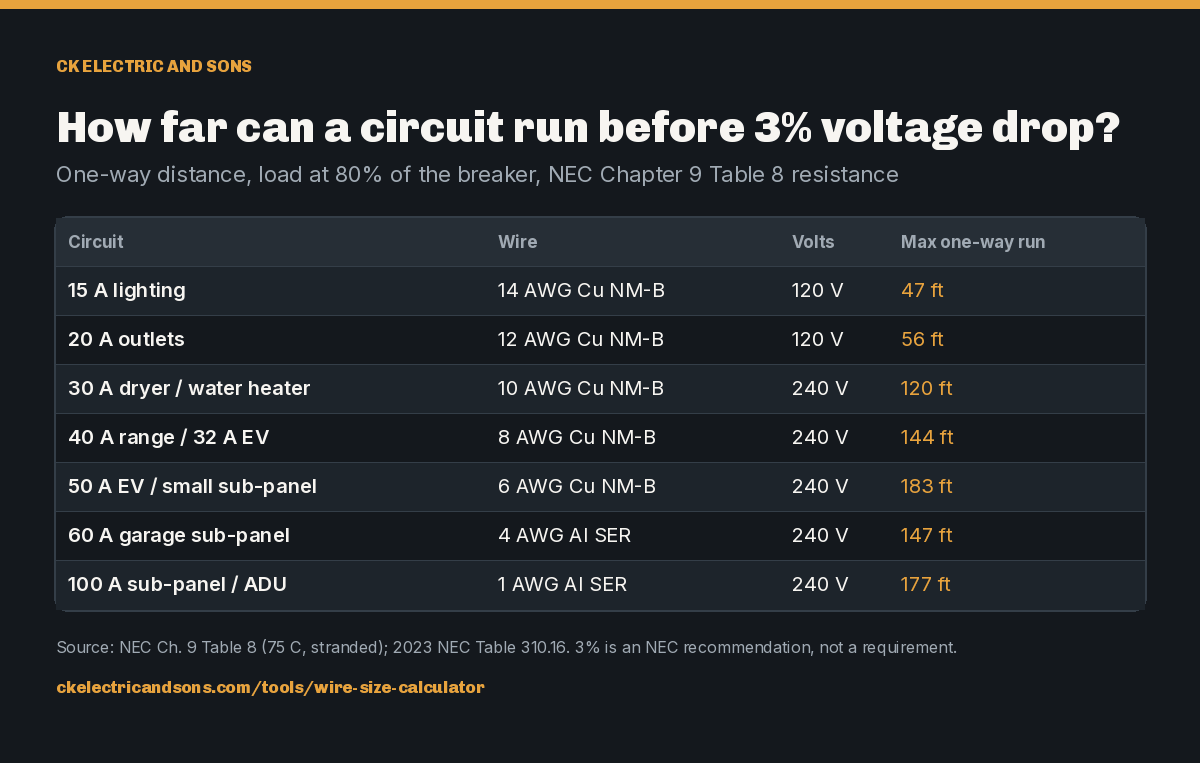
| Circuit | Wire | Volts | Max one-way run |
|---|---|---|---|
| 15 A lighting circuit | 14 AWG Cu NM-B | 120 V | 47 ft |
| 20 A outlet circuit | 12 AWG Cu NM-B | 120 V | 56 ft |
| 30 A dryer or water heater | 10 AWG Cu NM-B | 240 V | 120 ft |
| 40 A range or 32 A EV charger | 8 AWG Cu NM-B | 240 V | 144 ft |
| 50 A EV circuit or small sub-panel | 6 AWG Cu NM-B | 240 V | 183 ft |
| 60 A garage sub-panel | 4 AWG Al Al SER | 240 V | 147 ft |
| 100 A sub-panel or ADU feeder | 1 AWG Al Al SER | 240 V | 177 ft |
In 4 steps
- Pick whether you know the breaker size or the load in amps. For an EV charger or heater, enter the load and tick "3 hours or more" so it gets the 125% rule.
- Choose the voltage and measure the one-way distance along the path the wire will actually run, up and over, not a straight line.
- Pick the wiring method. NM-B (inside walls) uses the 60 °C column; wires in conduit and aluminum SER use 75 °C when the lugs are marked for it.
- Read the larger of the two sizes. If distance is the reason it went up, the note says so, and the table shows the next sizes either side.
Why there are two answers
Ampacity is about heat. Table 310.16 lists how much current a wire can carry before its insulation gets hotter than its rating, and the column you’re allowed to use depends on the weakest part of the circuit: NM-B cable is held to 60 °C by 334.80, and breaker lugs are 60 °C unless they’re marked 75 °C (110.14(C)).
Voltage drop is about distance. Every foot of wire has resistance, and the loss grows with length and current. The NEC only suggests limits, 3% on a branch circuit or feeder and 5% combined, in informational notes that aren’t enforceable. Motors, chargers and LED drivers still behave better when they get close to full voltage.
This tool uses the DC resistance in Chapter 9 Table 8. For house-size wire, 1/0 and smaller, the AC values in Table 9 are within a few percent (Mike Holt’s own example uses 2.0 Ω/kft for 12 AWG where Table 8 says 1.98). On 250 kcmil and larger in steel conduit, Table 9 runs higher, so a big commercial feeder deserves an engineer’s calculation. Need to know whether the panel can take the new load at all? Try the panel load calculator.
Wire size calculator: common questions
What size wire do I need for a 50 amp circuit?
6 AWG copper if it is NM-B cable, because 334.80 holds NM to the 60 °C column, where 6 AWG is 55 A and 8 AWG is only 40 A. In conduit with THHN and breaker and lugs marked 75 °C, 8 AWG copper (50 A) is allowed. Long runs can push either one up a size for voltage drop.
Is the 3% voltage drop rule a code requirement?
No. The 3% (branch or feeder) and 5% (combined) figures sit in NEC informational notes, which are recommendations, not requirements under 90.5(C). An inspector won't fail a circuit for a 4% drop on that basis alone, but an equipment manual can set its own limit, so check it for chargers and motors.
Can I use aluminum wire for a sub-panel?
Yes. Aluminum SER and aluminum building wire are allowed for feeders and are sized a step or two larger than copper: a 60 A feeder is 6 AWG copper or 4 AWG aluminum in the 75 °C column. The aluminum problem CPSC warns about is small branch-circuit wiring installed from 1965 to the mid-1970s, not modern feeders on lugs rated for aluminum.
What is the 83% rule for house services?
NEC 310.12 lets the service conductors of a one-family house, or a feeder that carries the whole house load, be sized at 83% of the service rating from 100 to 400 A. A 200 A service needs 166 A of conductor: 2/0 copper or 4/0 aluminum. It does not apply to a garage or ADU sub-panel, or where heat correction factors apply.
If the run is long, do I need a bigger breaker?
No. The breaker protects the wire, so it stays sized to the load. A long run gets bigger wire on the same breaker. Putting a bigger breaker on small wire is how wire overheats.
Why does 12 AWG copper show 25 A in the 75 °C column but only go on a 20 A breaker?
NEC 240.4(D) caps small copper conductors regardless of the table: 14 AWG at 15 A, 12 AWG at 20 A and 10 AWG at 30 A. The higher table values are only used as a starting point when heat or bundling correction factors apply.
Where these numbers come from
- ICC Store: 2025 California Electrical Code, Title 24, Part 3"Based on the 2023 National Electrical Code," effective January 1, 2026 (read Sep 22, 2026).
- California Building Standards Commission: 2025 CEC (Part 3) erratum, January 1, 2026Confirms the 2025 California Electrical Code's January 1, 2026 effective date (read Sep 22, 2026).
- WireSizes.com: NEC Table 310.16 — Conductor Ampacities (2023 edition)Copper and aluminum ampacities at 60/75/90 °C, 14 AWG–250 kcmil and 500 kcmil; the 240.4(D) caps of 15, 20 and 30 A (read Sep 22, 2026).
- elecalculator.com: NEC Table 310.16 Ampacity Chart [2023]300–500 kcmil rows, including aluminum 300 kcmil at 190 A (60 °C) (read Sep 22, 2026).
- HELUKABEL: Allowable Ampacity Tables, NFPA 70 NEC 2023Table 310.16 basis: 30 °C (86 °F) ambient, not more than three current-carrying conductors (read Sep 22, 2026).
- NEC Chapter 9, Table 8 — Conductor Properties (reprint)DC resistance at 75 °C in ohms per 1,000 ft, stranded uncoated copper and aluminum, and circular-mil areas (read Sep 22, 2026).
- Mike Holt: Voltage Drop Calculations — Part OneWorked examples used as test cases (6.4 V, 233.1 V, 3.5 V); Table 8 for DC and Table 9 for AC; fine print notes aren't enforceable (read Sep 22, 2026).
- Mike Holt, EC&M: Don't Let Voltage Drop Get Your System Down (June 1, 2004)3% for a feeder or branch, 5% combined; the notes to 210.19(A) and 215.2 are recommendations, not requirements [90.5(C)] (read Sep 22, 2026).
- Charles R. Miller, EC Magazine: Sizing Conductors, Part VINM cable ampacity may not exceed the 60 °C rating; the 90 °C rating is only for derating math [334.80] (read Sep 22, 2026).
- Building Code Geek: Conductor Ampacity, 60 °C vs 75 °C and Termination RatingsEquipment of 100 A or less, or conductors #1 AWG and smaller, use 60 °C unless listed and identified for 75 °C [110.14(C)] (read Sep 22, 2026).
- Southwire: UF-B Copper Cable (SPEC 10036)UF-B ampacity per 2023 NEC 340.80 at the 60 °C rating; sold 14 AWG through 6 AWG (read Sep 22, 2026).
- Mark C. Ode, EC Magazine: Heat Is the Enemy — Using 310.12 (May 14, 2024)83% of the service rating for 100–400 A one-family dwelling services and feeders carrying the entire load; not where correction factors apply (read Sep 22, 2026).
- Mike Holt, EC&M: Commercial Loads — Part 1Continuous load is 3 hours or more; conductors and breakers at 125% of it (read Sep 22, 2026).
- NEC Table 240.6(A) standard ampere ratingsStandard breaker sizes from 15 to 800 A, used to round a load up to a breaker (read Sep 22, 2026).
- CPSC Publication 516: Repairing Aluminum WiringThe aluminum-wiring hazard is small-gauge branch circuits installed from 1965 to the mid-1970s (read Sep 22, 2026).
Last reviewed . This tool is general information for planning, not a design or a permit document — your inspector and the code edition your city has adopted have the final word. Spot something wrong? Text Shane at (949) 702-0385 and it gets fixed.
Rather have a licensed electrician look at it?
Text Shane a photo of your panel or the problem. Photo quotes by text are free.
CSLB #354550 · C-10 Electrical · Licensed since 1978 · $25,000 contractor's bond