Problem panel checker: Zinsco, Federal Pacific & more
Federal Pacific Stab-Lok has the strongest evidence behind the warnings: CPSC testing, a 2002 court finding about its UL labels, and one engineer’s field sample where 48 % of double-pole breakers failed to trip. Zinsco’s breaker-to-bus connection can arc and weld, a concern backed by insurer guidance and field reports but no recall. Challenger has one 1988 GFCI-breaker recall, and Pushmatic, fuse and no-main panels are about age and design. Read the brand inside the panel door; never take the inner cover off.
Your panel
How to read the label without opening anything
- Find the panel: often on an outside wall with the meter, or in the garage.
- Open the hinged door only. The flat metal cover behind it (the dead-front, held on with screws) stays on. Never remove it.
- Look for the brand on the inside of the door, on a paper label glued to the dead-front, or embossed on the door itself. The label also lists the panel’s ampere rating and the breaker types it accepts.
- Read the main breaker: the largest handle, usually at the top, with its rating (100, 125, 150, 200) stamped on it. If there isn’t one, note that.
- Take one photo of the label and one of all the breakers with the door open. That’s all an electrician needs to identify it.
Result
What’s documented, and what kind of evidence it is
- Federal regulator
The CPSC closed a two-year investigation on March 3, 1983. It said its data did not establish a serious risk of injury, and that gathering the data to settle the question would cost several million dollars on a $34 million budget. It closed for lack of data and money, not with a finding that the breakers are safe.
CPSC statement, March 3, 1983 (reproduced by InspectApedia) - Court finding
An October 2002 New Jersey Superior Court order (Yacout v. Federal Pacific Electric) found FPE knowingly distributed breakers that were not tested to meet the UL standards shown on their labels. That's a finding about the labels and testing, not a measured failure rate.
Wikipedia, Stab-Lok (citing the court order); The Hanover Insurance Group - Independent testing
CPSC testing of 122 double-pole FPE breakers found 51 % failed on individual poles at 135 % of rating. In a field sample from 17 panels, consulting engineer Jesse Aronstein reported 14 % of single-pole and 48 % of double-pole breakers failed to trip. These are one engineer's compiled results on used breakers, not a random national sample.
J. Aronstein, Stab-Lok Testing Update (2004) - Insurer guidance
The Hanover Insurance Group advises that the safest course is to replace a Stab-Lok panel with a completely new panelboard and breakers.
The Hanover Insurance Group
What to do next
- Plan a panel replacement. The insurer guidance above is a completely new panelboard and breakers, not breaker-by-breaker swaps.
- Age isn’t a defect on its own. It’s a reason to have the connections, breakers and bus looked at once, especially before a remodel or a big new load.
This sorts what you can see from outside the panel. It isn’t an inspection. Never take the inner cover (the dead-front) off a live panel; that part is for a licensed electrician.
A Zinsco panel with aluminum wiring on the inspection report
Picture a house with its original panel. The door label reads “Sylvania-Zinsco,” and the buyer’s home inspector noted aluminum branch wiring and a panel over 40 years old. Nothing is warm, buzzing or tripping.
Flag level: Plan a replacement. The brand sets it. Great American Insurance Group’s loss-control guidance says to replace Zinsco equipment after an electrician inspects it, and the concern is the clip that holds each breaker to the bus. The aluminum wiring is a separate job: the CPSC’s permanent repairs are a copper rewire, COPALUM crimps or AlumiConn connectors, and its figure is that pre-1972 aluminum-wired homes are 55 times more likely to have a connection reach fire-hazard conditions.
What the checker lists next, in order:
- Plan a panel replacement. If a breaker is warm, buzzing or won’t reset, treat it as urgent.
- The CPSC’s permanent repairs are a copper rewire, COPALUM crimp connectors or AlumiConn connectors at every splice and device. It calls CO/ALR devices an incomplete repair at best and doesn’t accept twist-on connectors.
- Age isn’t a defect on its own. It’s a reason to have the connections, breakers and bus looked at once, especially before a remodel or a big new load.
Swap the label for a current brand with the same 40-year age and the result drops to “Worth a look”: age alone is a reason to look, not a defect. When the panel does need to go, a panel replacement is permitted work and we pull the permit and coordinate the utility.
Panels that get flagged, and what the evidence is
Each concern is labeled by the kind of evidence behind it. A recall or a court finding isn’t the same thing as an insurer’s advice or a home inspector’s field reports, and this table keeps them apart.
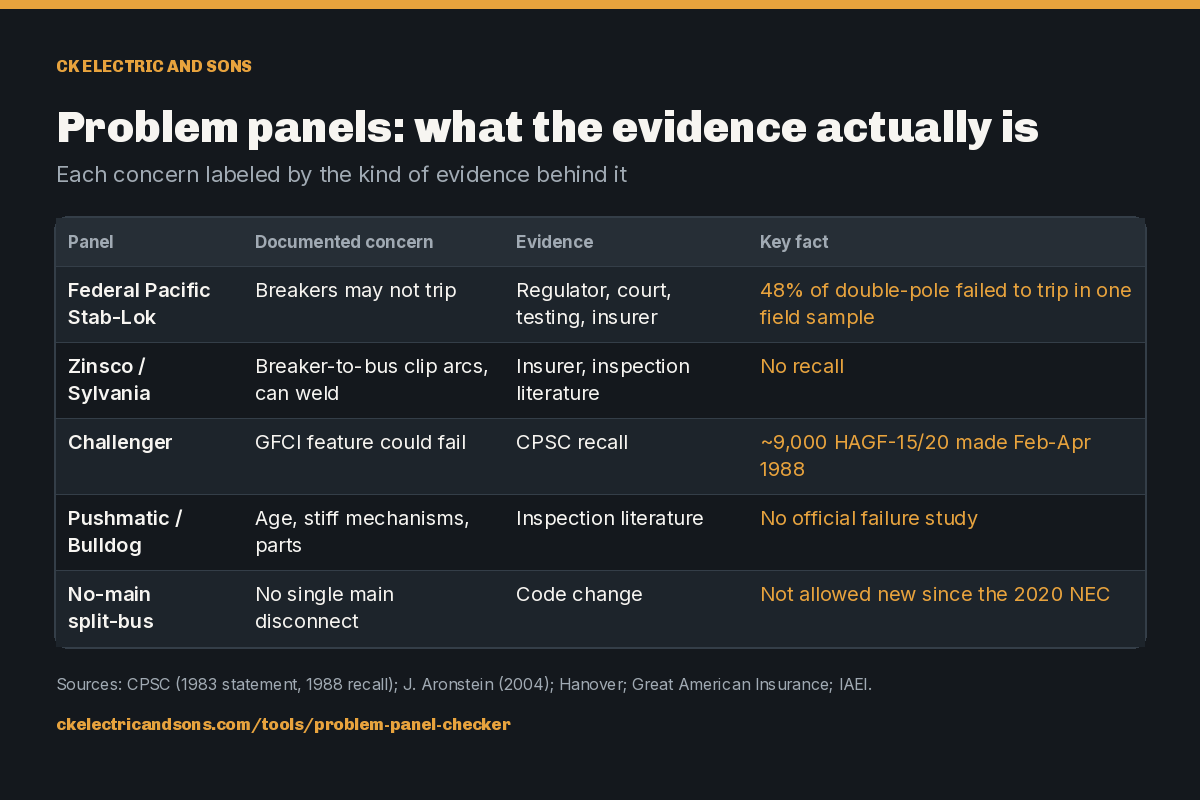
| Panel | What the label says | Documented concern | Evidence | Checker says |
|---|---|---|---|---|
| Federal Pacific Electric (FPE) Stab-Lok | "Federal Pacific", "FPE" or "Stab-Lok" on the door label or the panel face. | Breakers that may not trip when they should. A breaker that stays on through an overload or short leaves the wire to overheat. | Federal regulator, Court finding, Independent testing, Insurer guidance | Plan a replacement |
| Zinsco / Sylvania-Zinsco / GTE-Sylvania | "Zinsco", "Sylvania", "Sylvania-Zinsco" or "GTE-Sylvania" on the door or label. | The connection between each breaker and the bus bar. It can loosen and arc, overheat, and in the worst case weld the breaker to the bus so it can’t trip. | Insurer guidance, Inspection literature | Plan a replacement |
| Challenger | "Challenger" embossed on the panel door or printed on the label (the CPSC recall notice says to look there). | One specific recall: GFCI breakers whose ground-fault protection could stop working. Other Challenger concerns you may read about online are field reports, not recalls. | Product recall | Have it evaluated |
| Pushmatic / Bulldog | "Pushmatic" or "Bulldog" on the label; push-button breakers instead of toggles. | Age. Push-button breakers can get stiff when they’re never operated, some panels have no main breaker, and replacement parts are hard to find. | Inspection literature | Have it evaluated |
| Fuse box | Round screw-in fuses (plug fuses) or cartridge fuses instead of breakers. | Overfusing: a 30 A fuse screwed into a socket wired for 15 A lets the wire overheat before the fuse blows. Old-style Edison-base fuses are all interchangeable, which is why this happens. | Electrical code | Have it evaluated |
| Split-bus panel with no main breaker | No single large breaker at the top; instead up to six larger breakers that together shut off the house (the "rule of six"). | Shutting the house off takes several handles, and there’s no single main protecting the panel. It was legal when installed; new ones aren’t. | Electrical code | Have it evaluated |
| What you noticed | Checker says | Why |
|---|---|---|
| Burning smell, scorch marks or melted plastic | Act now | Turn off the breaker for that circuit, or the main if you can reach it without touching anything damaged, and call an electrician now. Don’t reset it and wait. |
| Panel or a breaker is warm to the touch, or buzzing | Act now | Warmth or a buzz from the panel usually means a connection is heating. Get it looked at now; if it’s hot or smells, shut off that breaker or the main and call. |
| Rust, water stains or corrosion | Have it evaluated | Water inside a panel corrodes the bus and breaker connections. Find where the water is getting in and have the inside checked. |
| A breaker trips often | Worth a look | Usually an overloaded circuit or a failing appliance, sometimes a bad breaker or connection. Worth a diagnosis; don’t tape or hold a breaker on. |
| A breaker stayed on when it should have tripped | Have it evaluated | A breaker that doesn’t trip is the dangerous failure. Have that breaker and the panel tested. |
| An inspector noted double-tapped breakers | Worth a look | A common home-inspection write-up, and usually a small fix while someone’s in the panel anyway. |
| An inspector noted aluminum branch wiring | Have it evaluated | The CPSC’s permanent repairs are a copper rewire, COPALUM crimp connectors or AlumiConn connectors at every splice and device. It calls CO/ALR devices an incomplete repair at best and doesn’t accept twist-on connectors. |
| No main breaker | Have it evaluated | A split-bus or no-main panel. Legal when installed, not allowed as a new service panel since the 2020 NEC. Worth an evaluation, and a strong reason to replace if you’re adding load. |
| The panel is 40 years old or more | Worth a look | Age isn’t a defect on its own. It’s a reason to have the connections, breakers and bus looked at once, especially before a remodel or a big new load. |
How to read the label without opening anything
- Find the panel: often on an outside wall with the meter, or in the garage.
- Open the hinged door only. The flat metal cover behind it (the dead-front, held on with screws) stays on. Never remove it.
- Look for the brand on the inside of the door, on a paper label glued to the dead-front, or embossed on the door itself. The label also lists the panel’s ampere rating and the breaker types it accepts.
- Read the main breaker: the largest handle, usually at the top, with its rating (100, 125, 150, 200) stamped on it. If there isn’t one, note that.
- Take one photo of the label and one of all the breakers with the door open. That’s all an electrician needs to identify it.
In 4 steps
- Open the panel door (the hinged part only) and find the brand on the label, the door or the dead-front.
- Pick the brand or type. If you can’t tell, pick “Can’t tell” and take the photo it asks for.
- Tick anything you’ve noticed or an inspector has written up: rust, heat, tripping, aluminum wiring, no main.
- Read the flag level, the evidence behind it, and the next steps in order.
Why some panels get flagged and others don’t
A breaker has one job that matters most: open when the current is too high. The Federal Pacific concern is exactly that. The CPSC closed its investigation in 1983 saying its data didn’t establish a serious risk and that settling it would cost several million dollars, which is a statement about data and budget, not a clean bill of health. A New Jersey court later found the breakers weren’t tested to the UL standards on their labels, and one engineer’s testing of used breakers found high no-trip rates.
Zinsco’s problem is the joint between breaker and bus. When that joint loosens it heats, and heat makes it worse. No recall was ever issued; the case against Zinsco rests on field reports and insurer guidance. Pushmatic and split-bus panels are mostly about age and design: stiff mechanisms, scarce parts and, on some, no single main.
None of this replaces an electrician opening the panel. Condition beats brand: a corroded modern panel can be worse than a dry, tight old one. Our panel load calculator helps if you’re also deciding how big the replacement should be.
Problem panel checker: common questions
Was there ever a recall of Federal Pacific Stab-Lok breakers?
No. The CPSC closed its investigation on March 3, 1983 without a recall, saying its data did not establish a serious risk and that gathering enough data would cost several million dollars. In October 2002 a New Jersey Superior Court order found the breakers were not tested to the UL standards shown on their labels.
Is a Zinsco panel dangerous?
The documented concern is the aluminum clip that connects each breaker to the bus. It can loosen, arc and overheat, and a breaker can weld to the bus so it won’t trip. There was no recall; insurers such as Great American recommend replacing Zinsco panels after an electrician inspects them.
Which Challenger breakers were recalled?
About 9,000 Challenger type HAGF-15 and HAGF-20 GFCI breakers made between February 22 and April 29, 1988, announced by the CPSC on November 12, 1988. A part could detach and stop the ground-fault protection from working. Recalled units have a yellow test button and white 15 or 20 on the handle.
How can I tell what brand my panel is without opening it?
Open only the hinged door. The brand is usually on a paper label inside the door or on the flat cover behind it, or embossed on the door. Don’t unscrew that flat cover (the dead-front). A photo of the label and the breakers is enough for an electrician to identify it.
What years was aluminum wiring used in houses?
The CPSC says aluminum branch wiring went into new homes from 1965 to the mid-1970s, and that pre-1972 aluminum-wired homes are 55 times more likely than copper-wired homes to have a connection reach fire-hazard conditions. Its permanent repairs are a copper rewire, COPALUM crimp connectors or AlumiConn connectors.
Where these numbers come from
- CPSC statement on FPE Stab-Lok breakers, March 3, 1983 (reproduced by InspectApedia)CPSC closed its two-year investigation: data did not establish a serious risk; gathering it would cost several million dollars on a $34 million FY1983 budget (read Sep 22, 2026).
- Wikipedia — Stab-LokCPSC testing found breakers failing certain UL calibration tests; October 2002 New Jersey Superior Court order (Yacout v. Federal Pacific Electric) on breakers not tested to the UL standards on their labels; made primarily 1950–1980 (read Sep 22, 2026).
- The Hanover Insurance Group — Federal Pacific Electric (FPE) Stab-Lok breakers and panelboardsCourt ruling on UL labels; installed 1950–1985; recommends a completely new panelboard and breakers (read Sep 22, 2026).
- J. Aronstein, Ph.D., P.E. — FPE Stab-Lok Testing Update (2004)CPSC tests of 122 double-pole breakers: 51 % failed at 135 % on individual poles. Field sample of 246 breakers from 17 panels: 14 % of single-pole and 48 % of double-pole failed to trip (read Sep 22, 2026).
- Great American Insurance Group — Is Your Electric Panel a Fire Risk?Zinsco aluminum bus clip and arcing; label names Zinsco, Sylvania, Sylvania-Zinsco, GTE-Sylvania; common in the 1970s, especially in the West; replace (read Sep 22, 2026).
- Wikipedia — ZinscoLoose bus connection, arcing, breakers fused to the bus and contacts fused closed; sold to GTE-Sylvania in 1973; no recall mentioned (read Sep 22, 2026).
- CPSC — Challenger Electrical Equipment Corp. replacement program for 9,000 GFCI circuit breakers (Nov 12, 1988)Type HAGF-15 and HAGF-20 GFCI breakers made Feb 22–Apr 29, 1988; identification by yellow test button and white numbers on the handle (read Sep 22, 2026).
- InspectApedia — Pushmatic Bulldog and ITE Pushmatic panelsMostly 1950s–60s; stiff mechanisms, some with no main breaker, parts hard to find; no official study of failure-to-trip rates (read Sep 22, 2026).
- IAEI Magazine — The 6-Disconnect Rule (March 25, 2020)2020 NEC 230.71(B): each service panelboard must have its own main disconnect (read Sep 22, 2026).
- IAEI Magazine — Article 240, Part 2: Overcurrent Protection (March 16, 2013)Edison-base fuses only as replacements with no evidence of overfusing or tampering; Type S fuses and adapters (read Sep 22, 2026).
- CPSC Publication 516 — Repairing Aluminum WiringInstalled 1965 to the mid-1970s; pre-1972 homes 55 times more likely to reach fire-hazard conditions; permanent repairs; CO/ALR and twist-on connectors; warning signs (read Sep 22, 2026).
- California Building Standards Commission — Codes (2025 Title 24)2025 California Electrical Code (based on the 2023 NEC) effective January 1, 2026 (read Sep 22, 2026).
Last reviewed . This tool is general information for planning, not a design or a permit document — your inspector and the code edition your city has adopted have the final word. Spot something wrong? Text Shane at (949) 702-0385 and it gets fixed.
Rather have a licensed electrician look at it?
Text Shane a photo of your panel or the problem. Photo quotes by text are free.
CSLB #354550 · C-10 Electrical · Licensed since 1978 · $25,000 contractor's bond