Why does my breaker keep tripping? Troubleshooter
A breaker that holds for a while and then trips is usually overloaded (one 1,500-watt heater draws 12.5 amps of a 15-amp circuit). One that trips the instant you reset it points to a short or a ground fault, and a GFCI that trips in the rain is finding water. A burning smell, a hot or buzzing breaker, scorch marks or water at the panel means stop: switch it off and call an electrician.
Four questions
What to do, cheapest first
What this pattern usually points to
- Overload. More current than the breaker is rated for, for long enough to heat its thermal trip. Heaters, hair dryers, kettles and toasters sharing one circuit are the usual reason: a 1,500-watt heater alone draws 12.5 amps on 120 volts.
- A failing breaker or loose connection. A worn breaker, or a loose connection where the breaker clips onto the panel or where the wire lands on it. That spot heats up and the breaker trips on its own heat. This one is for an electrician.
Check in this order
- Look for a tripped GFCI outlet first
Check the outlets in bathrooms, the kitchen, the garage, outdoors and the laundry for one with its RESET button popped out, and press RESET. One GFCI outlet protects the outlets wired after it, so a dead outlet in one room can be caused by a GFCI in another.
Look only - Find the tripped breaker
Open the panel door only (not the inner cover). A tripped breaker sits OFF or stuck in the middle between ON and OFF. The labels on the door should say which circuit it is.
Look only - Write down what was running when it tripped
Which lights, what was plugged in, what had just switched on, the time of day, the weather. That is the most useful thing you can hand an electrician, and it often solves it on its own.
Look only - Reset it once, the right way
Push the handle all the way to OFF first, then firmly to ON. A tripped breaker won’t reset from the middle position. If it trips again right away, leave it off.
Safe to do yourself - Move the heat-makers to a different circuit
Add up the watts on the circuit and divide by 120 to get amps. A space heater, hair dryer, kettle or toaster on the same circuit as other things is the classic overload. Move one to an outlet on a different breaker.
Safe to do yourself - Unplug everything on the circuit, then add things back one at a time
Unplug or switch off everything the circuit feeds, reset, then plug things back in one at a time with a few minutes between each. The one that trips it is your suspect.
Safe to do yourself - Call a licensed electrician
Tell them which breaker, when it trips, what was running, and what you already tried. A photo of the panel label and the breaker helps.
Electrician
Stop and call if
- It trips again with everything on the circuit unplugged or switched off.
- The same breaker keeps tripping, even if you can reset it. Frequent trips mean a problem.
- You can’t find a reason for the trip.
- Any of the stop signs shows up: a burning smell, heat, buzzing, scorch marks, water, or a shock.
Don’t
- Don’t swap in a bigger breaker. The breaker is sized to protect the wire; a bigger one lets the wire overheat.
- Don’t hold, tape or block a breaker ON.
- Don’t take off the panel’s inner cover or test wires. That is live equipment.
- Don’t keep resetting a breaker that trips the instant it goes on.
This narrows it down; it can’t see your wiring. Everything above is done from outside the panel. If a step feels unsafe, skip it and call.
A bedroom AFCI that trips 20 minutes after the space heater goes on
The answers: an AFCI breaker (it has a TEST button and says AFCI), it trips after things run for a while, and there’s a space heater on the circuit. No burning smell, no heat at the panel.
What it points to: overload, then a failing breaker or loose connection, then arc fault. The heater alone is 1,500 W ÷ 120 V = 12.5 A. Add a TV, lamps and a phone charger and a 15 A circuit is out of room, so the heat-sensing part of the breaker trips after a few minutes.
Checks, cheapest first:
- Find the tripped breaker.
- Write down what was running when it tripped.
- Look over cords, plugs and bulbs on that circuit.
- Reset it once, the right way.
- Press TEST, then reset.
- Move the heat-makers to a different circuit.
- Unplug everything on the circuit, then add things back one at a time.
- Square D QO or Homeline arc-fault or dual-function breaker? Ask it what it saw.
- Call a licensed electrician.
If it still trips with the heater on its own circuit, that’s no longer an overload, and the AFCI may be seeing arcing in a cord, a loose connection or the heater itself. That’s the point to call.
What the timing of a trip usually means
Read across from when it trips. The causes are listed in the order the pattern fits them, for a regular breaker; GFCIs and AFCIs add their own causes, which the tool above includes. None of this is a probability, and none of it replaces an electrician looking at the circuit.
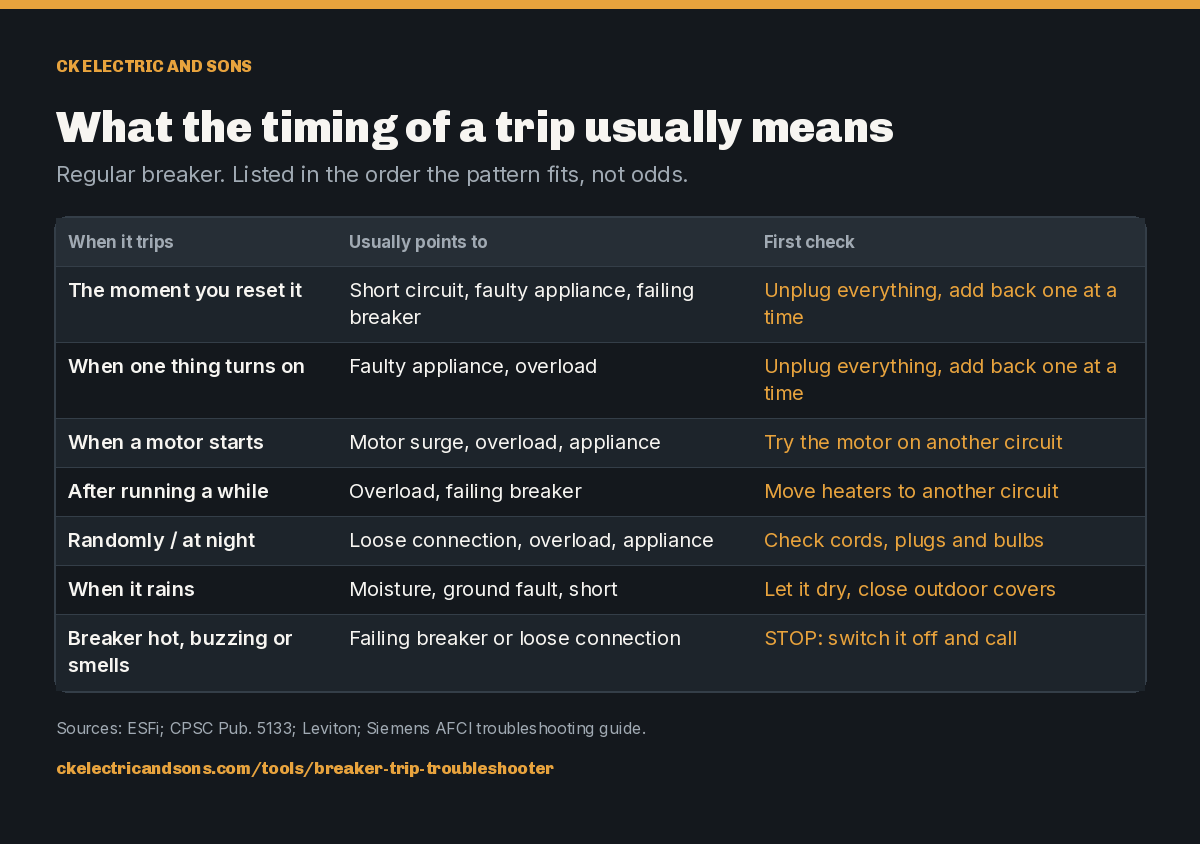
| When it trips | Usually points to | First thing to check |
|---|---|---|
| The moment I reset it | Short circuit · One faulty appliance or cord · A failing breaker or loose connection | Unplug everything on the circuit, then add things back one at a time |
| When one thing is turned on or plugged in | One faulty appliance or cord · Overload | Unplug everything on the circuit, then add things back one at a time |
| When a motor starts | Motor starting surge · Overload · One faulty appliance or cord | Try the motor appliance on a different circuit |
| After things run for a while | Overload · A failing breaker or loose connection | Move the heat-makers to a different circuit |
| Randomly, or at night | A failing breaker or loose connection · Overload · One faulty appliance or cord | Look over cords, plugs and bulbs on that circuit |
| When it rains or after watering | Moisture · Ground fault · Short circuit | Let it dry, and check the outdoor covers |
| The breaker is hot, buzzing or smells | A failing breaker or loose connection · Overload | Stop. Switch it off and call. |
| Device | Trips on | Has a TEST button |
|---|---|---|
| Regular breaker | Overload and short circuit | No |
| GFCI (outlet or breaker) | Ground fault: current leaking out, Class A trips at 6 mA, holds below 4 mA | Yes |
| AFCI breaker | Arcing in the wiring or cords, plus overload and short circuit | Yes |
| Dual-function breaker | Both of the above in one breaker | Yes |
| After you hold TEST and switch ON | What the breaker last saw |
|---|---|
| Trips in under 1 second | Fault to ground: arcing to ground, shared neutral, grounded neutral, ground fault |
| Trips at about 2 seconds | Arc fault: parallel or series |
| Trips at about 5 seconds | Procedure complete: no fault, thermal overload or short circuit |
In 4 steps
- Pick what tripped. Read the face of the breaker from the panel door: a TEST button and a label tell you if it is a GFCI, AFCI or dual-function.
- Pick when it trips. The timing says more than anything else about the cause.
- Tick what is on that circuit, and any danger signs. A danger sign ends the troubleshooting.
- Work the checks top to bottom and stop at the first one that finds it. If none do, the last step is the call.
Three kinds of protection, three kinds of trip
A regular breaker watches for too much current. A little too much for a while (an overload) heats its trip until it lets go; a lot at once (a short circuit) trips it instantly. CPSC points out that it doesn’t respond to early arcing and sparking. That’s the AFCI’s job.
A GFCI compares the current going out with the current coming back. If 6 milliamps goes missing, through water or a person, it trips. That’s why GFCIs trip in the rain and regular breakers don’t. An AFCI listens for the signature of arcing: a loose connection, a crushed cord, a nail through a cable.
So a trip is information. Each one tells you which kind of problem to look for. The GFCI and AFCI guide covers where California code requires each, and the problem panel checker covers panels whose breakers are known for not tripping at all.
Breaker trip troubleshooter: common questions
Why does my breaker trip when I run a space heater?
A 1,500-watt heater draws 12.5 amps on 120 volts, most of a 15-amp circuit by itself. Anything else on the same circuit tips it into an overload, and the breaker trips after a few minutes. Move the heater to an outlet on a different breaker. If it trips with the heater alone, have the circuit checked.
Is it safe to keep resetting a breaker?
Reset it once, all the way OFF and then ON. If it trips again right away, leave it off: something is faulted right now. ESFi says frequent trips indicate a problem and should be inspected by a qualified electrician.
Why does my outdoor GFCI trip when it rains?
Water is reaching something live, usually an outdoor outlet, a landscape light or a fixture box. A Class A GFCI trips when 6 milliamps goes missing, so a little moisture is enough. Close the covers and let things dry. If it trips every time it gets wet, the box or fixture needs repair.
Why does my AFCI breaker trip with nothing plugged in?
That points at the wiring, not your appliances. Siemens and Schneider both list shared or grounded neutrals among the causes, and a nail or screw through a cable can do it too. It needs an electrician. On a Square D QO or Homeline arc-fault breaker, the Time Saver Diagnostics trip timing can tell the electrician what it saw.
Can I put in a bigger breaker so it stops tripping?
No. The breaker is sized to protect the wire in the wall. NEC 240.4(D) limits 14 AWG copper to 15 amps and 12 AWG to 20 amps. A bigger breaker lets that wire overheat before anything trips.
How often should I test GFCI and AFCI devices?
Monthly, per ESFi and Leviton. Press TEST: the power should cut off. Press RESET: it should come back. If TEST does nothing or it won’t reset, the device has failed and needs replacing.
Where these numbers come from
- Electrical Safety Foundation International (ESFi): Fuse and Breaker BreakdownBreakers trip when current exceeds their rating; "Frequent trips of a breaker indicate a problem and should be inspected by a qualified electrician" (read Sep 22, 2026).
- ESFi: Understanding Your Home Electrical SystemA tripped breaker sits OFF or in a middle position; call an electrician when trips persist after a reset; what AFCIs detect (read Sep 22, 2026).
- ESFi: Ground Fault Circuit Interrupters (GFCI)Test GFCIs every month; TEST should cut the power and RESET should restore it (read Sep 22, 2026).
- U.S. Consumer Product Safety Commission: Preventing Home Fires — AFCIs (Publication 5133)Ordinary breakers "do not respond to early arcing and sparking conditions"; AFCIs address fire, GFCIs address shock (read Sep 22, 2026).
- Leviton: GFCI Trips — What to do when your GFCI trips (application note)Look for discoloration and loose plugs, note what was running, unplug the suspect; one GFCI protects outlets downstream; call if it keeps tripping or the reason isn't obvious (read Sep 22, 2026).
- Leviton: How to test a Leviton GFCITest monthly; a GFCI that fails the test should be replaced by a licensed electrician (read Sep 22, 2026).
- Leviton: Tech Talk — GFCI and Tamper-Resistant ReceptaclesGFCIs trip at 4.0 to 6.0 mA (read Sep 22, 2026).
- Mark C. Ode, EC Magazine: Special-Purpose GFCIs (February 15, 2015)NEC note: Class A GFCIs trip at 6 mA or higher and do not trip below 4 mA; UL 943 is the GFCI standard (read Sep 22, 2026).
- Siemens: Combination Type AFCI Troubleshooting Guide (RPFL-COMB1-0712)Common causes on newer installs: shorts, overloads, a single-pole AFCI on a shared-neutral circuit; tight bulbs, cords under furniture, blackened plugs; add up loads and move some (read Sep 22, 2026).
- Schneider Electric FAQ FA125415: QO, QOB and HOM CAFI and Dual Function breaker Time Saver DiagnosticsTrip timing codes: under 1 s fault to ground, 2 s arc fault, 5 s no fault / overload / short; remove loads first (read Sep 22, 2026).
- WireSizes.com: NEC Table 310.16 and 240.4(D)240.4(D) caps the breaker on 14, 12 and 10 AWG copper at 15, 20 and 30 A, which is why a bigger breaker is never the fix (read Sep 22, 2026).
Last reviewed . This tool is general information for planning, not a design or a permit document — your inspector and the code edition your city has adopted have the final word. Spot something wrong? Text Shane at (949) 702-0385 and it gets fixed.
Rather have a licensed electrician look at it?
Text Shane a photo of your panel or the problem. Photo quotes by text are free.
CSLB #354550 · C-10 Electrical · Licensed since 1978 · $25,000 contractor's bond