Backup power sizing: generator or home battery
Keeping a refrigerator, ten LED lights, the internet, a TV, a microwave and a CPAP running takes about 2,290 W, and 3,090 W for the moment the fridge compressor starts, so a generator rated for at least that many starting watts covers it. Over a 24-hour outage that list uses about 7.4 kWh, which one 13.5 kWh Powerwall 3 or 2 Enphase IQ Battery 5P units (5 kWh each) can hold.
What has to stay on
Kitchen & essentials
Heating & cooling
Pumps & motors
Special
Hours each one is on per day
Starting guesses. Change them to match your house. Fridges and freezers default to 8 because they run about a third of the time.
What it takes
Peak: 2,290 W + largest extra surge 800 W = 3,090 W
Generac’s stricter worksheet method (running + highest starting): 3,490 W
Energy: Σ watts × (hours/day ÷ 24) × 24 h = 3.2 + 0.9 + 0.48 + 1.6 + 0.3 + 0.96 = 7.44 kWh
With 10% left over: 7.44 ÷ 0.9 = 8.27 kWh
- Tesla Powerwall 3
- 1 unit · 13.5 kWh · 11.5 kW
- Enphase IQ Battery 5P
- 2 units · 10 kWh · 7.68 kW
- FranklinWH aPower 2
- 1 unit · 15 kWh · 10 kW
Units = whichever is larger: enough published usable kWh for the energy, or enough continuous kW for everything on at once. 13.5 kWh AC and up to 11.5 kW per unit. Expansion units add 13.5 kWh each without adding output.
Wattages are the top of each published range, so this errs big. Your appliance nameplates beat any chart. General information only; your inspector and city have the final word on the hookup.
The outage essentials list, 24 hours
Loads: a refrigerator, ten LED bulbs, the modem and router, a 32- to 55-inch TV, a microwave and a CPAP with a heated humidifier. Wattages are the top of the published ranges.
Running: 400 + 150 + 20 + 400 + 1,200 + 120 = 2,290 W. The fridge is the only motor; it starts at 1,200 W, 800 W more than it runs at, so the peak is 2,290 + 800 = 3,090 W. Generac’s stricter worksheet method adds the full starting number instead and gets 3,490 W.
Energy: the fridge runs about a third of the time, so 400 W × 8 h = 3.2 kWh. Add lights 6 h, router 24 h, TV 4 h, microwave 15 minutes and CPAP 8 h, and the day totals 7.44 kWh. Keeping 10% in the battery at the end: 7.44 ÷ 0.9 = 8.27 kWh.
Batteries: one Powerwall 3 (13.5 kWh, 11.5 kW). Enphase IQ Battery 5P: 2 for the energy, 1 for the power, so 2. One FranklinWH aPower 2 (15 kWh, 10 kW).
Running and starting watts, and what the batteries hold
Starting watts only matter for motors: compressors, pumps, blowers and openers. Charts disagree. Honda lists a refrigerator at 700 W running and 2,200 W starting; Champion’s 2026 chart says 150–400 W and 800–1,200 W. We use Champion’s newer ranges at their top end. The nameplate on your own appliance beats both.
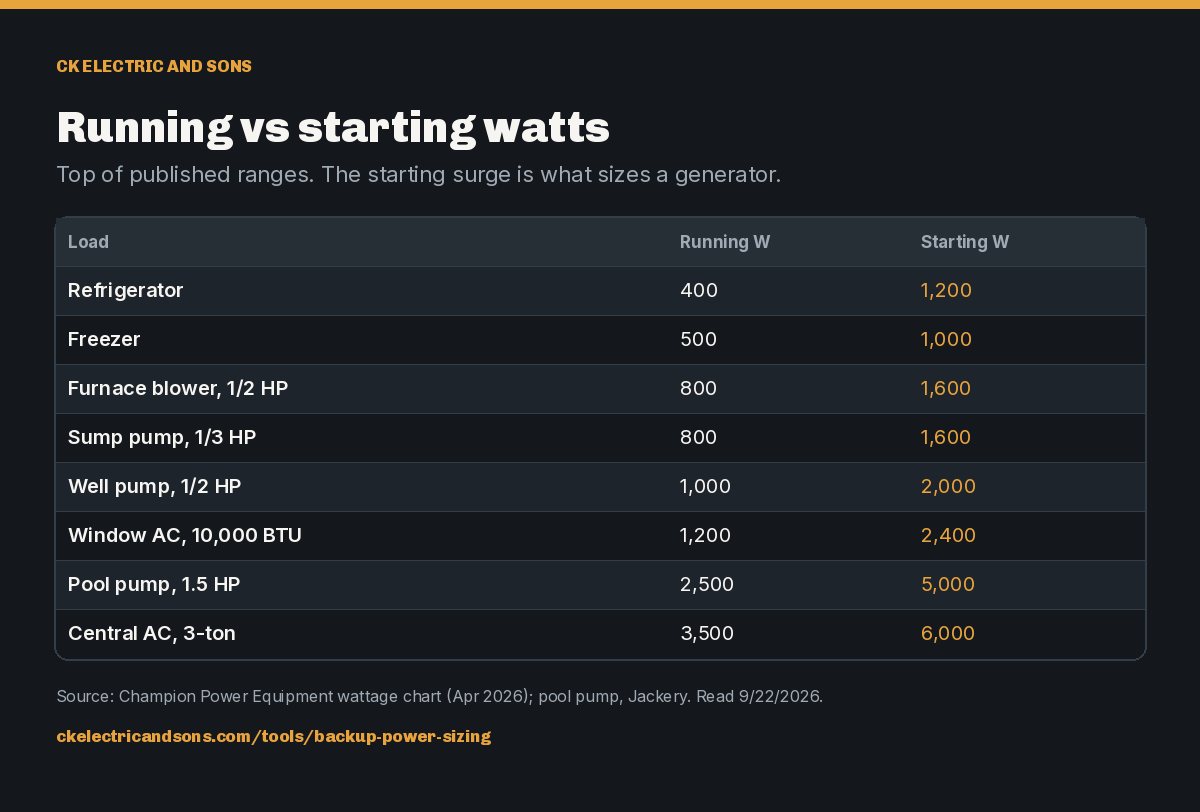
| Load | Running W | Starting W | Source |
|---|---|---|---|
| Refrigerator | 400 | 1,200 | Champion wattage chart, 2026: 150–400 W running, 800–1,200 W starting; runs about a third of the time |
| Freezer | 500 | 1,000 | Champion wattage chart, 2026: 100–500 W running, 500–1,000 W starting; cycles like a fridge |
| LED lighting, 10 bulbs | 150 | 150 | Champion wattage chart, 2026: 8–15 W per LED bulb × 10 |
| Internet modem and router | 20 | 20 | Champion wattage chart, 2026: 10–20 W |
| TV (32 to 55 inch) | 400 | 400 | Champion wattage chart, 2026: 80–400 W |
| Microwave | 1,200 | 1,200 | Champion wattage chart, 2026: 600–1,200 W |
| Coffee maker | 1,200 | 1,200 | Virginia Cooperative Extension / DOE method: 900–1,200 W |
| Gas furnace blower (1/2 HP) | 800 | 1,600 | Champion wattage chart, 2026: 300–800 W running, 800–1,600 W starting |
| Space heater | 1,500 | 1,500 | Champion wattage chart, 2026: 750–1,500 W |
| Window AC (10,000 BTU) | 1,200 | 2,400 | Champion wattage chart, 2026: 900–1,200 W running, 1,800–2,400 W starting |
| Central AC (3-ton) | 3,500 | 6,000 | Champion wattage chart, 2026: 3,000–3,500 W running, 5,000–6,000 W starting |
| Heat pump (3-ton) | 3,500 | 6,000 | Champion wattage chart, 2026: Uses the 3-ton central AC figures; check your nameplate |
| Well pump (1/2 HP) | 1,000 | 2,000 | Champion wattage chart, 2026: 750–1,000 W running, 1,500–2,000 W starting |
| Sump pump (1/3 HP) | 800 | 1,600 | Champion wattage chart, 2026: 500–800 W running, 1,000–1,600 W starting |
| Garage door opener (1/2 HP) | 500 | 1,100 | Champion owner’s manual chart: 500 W running + 600 W additional starting |
| Pool pump (1.5 HP, single speed) | 2,500 | 5,000 | Jackery pool pump guide: 2,000–2,500 W running, 4,000–5,000 W surge |
| Battery | Usable energy | Continuous output | Short peak | Round trip |
|---|---|---|---|---|
| Tesla Powerwall 3 | 13.5 kWh | 11.5 kW | Motor starting listed as 185 LRA | 89% |
| Enphase IQ Battery 5P | 5 kWh | 3.84 kW | 7.68 kW for 3 seconds per battery | 90% |
| FranklinWH aPower 2 | 15 kWh | 10 kW | 15 kW for 10 seconds, 185 A LRA per unit | 90% |
In 5 steps
- Check everything that has to keep running. Leave off what can wait until the power comes back.
- Adjust the hours each thing is on per day. Fridges and freezers already assume they run a third of the time.
- Set how long the outage should be covered and how much battery you want left at the end.
- Read the generator line as running watts and starting watts, and the battery lines as units of each model.
- Text a photo of your panel before you buy. The hookup is where most of the work and the code rules are.
Hooking it up: interlock, inlet or transfer switch
A generator or battery that powers house circuits is an optional standby system under 2023 NEC Article 702, and 702.5 requires interconnection or transfer equipment that is listed and designed so the utility and the backup source can never connect. For a portable generator that means one of two setups.
- Interlock kit and power inlet. A sliding plate on the panel that won’t let the generator breaker turn on while the main is on, plus an outdoor inlet box the generator cord plugs into. The kit has to be one listed for your panel. You pick which circuits to run by flipping breakers. A 30 A, 240 V inlet carries up to 7,200 W; a 50 A inlet, 12,000 W.
- Transfer switch. A separate switch, manual or automatic, that moves a set of circuits (or the whole house) from utility to generator. Standby generators and whole-home batteries use this approach; Powerwall 3 does it with Backup Gateway 3 or a Backup Switch at the meter.
Never backfeed through a dryer or wall outlet with a double-ended cord. The CPSC calls it backfeeding and says never to do it: it’s an electrocution risk to utility workers and to neighbors on the same transformer. Run a portable generator outside only, at least 20 feet from the house with the exhaust aimed away, never in the garage with the door open, and put battery-backed CO alarms on every level.
Shutoffs in South Orange County
SDG&E serves South Orange County along with San Diego County, and it sends Public Safety Power Shutoff notices about 48, 24 and 12 hours out, then 1 to 4 hours before. Power stays off as long as the fire threat does, and patrols need 4 to 8 hours of daylight before it comes back. SCE says its shutoffs may last over 24 hours, and it runs a Critical Care Backup Battery program for customers on medical devices. Not sure which one serves your street? The utility finder sorts it out.
We wire the inlet, interlock, transfer switch or battery hookup and pull the permit; see solar-ready panels and battery backup.
Backup power sizing: common questions
What size generator do I need to run a refrigerator?
Plan on about 400 W running and 1,200 W starting for a refrigerator, the top of Champion’s published range. Add your other loads’ running watts, then add the largest single starting surge. A fridge, lights, internet and a TV together need roughly 1,000 W running and 1,800 W at the moment the fridge starts.
How many kWh of battery do I need for a power outage?
Add up watts × hours for what has to stay on. A fridge, ten LED bulbs, internet, a TV, a microwave and a CPAP use about 7.4 kWh over 24 hours with the tool’s default hours. One 13.5 kWh Powerwall 3 or two 5.0 kWh Enphase IQ Battery 5P units cover that with some left over.
Can a home battery run central air conditioning?
Sometimes. A 3-ton central AC runs at up to 3,500 W and starts at up to 6,000 W on Champion’s chart. That’s within one Powerwall 3’s 11.5 kW continuous output, but it drains 13.5 kWh in about four hours of steady running. The compressor’s starting surge is the part to check with the installer.
Is a generator interlock kit legal in California?
A listed interlock kit made for your specific panel, installed with a permit, is one of the transfer methods 2023 NEC 702.5 allows, since it prevents the generator and the utility from ever being connected together. California’s 2025 Electrical Code is based on the 2023 NEC. Your city’s inspector has the final word.
Why can’t I plug my generator into the dryer outlet?
That’s backfeeding, and the CPSC says never to do it. It puts utility workers and neighbors on the same transformer at risk of electrocution, and it bypasses some of the house’s built-in circuit protection. A power inlet with a listed interlock, or a transfer switch, does the same job with nothing left to chance.
Where these numbers come from
- Champion Power Equipment: Generator Wattage ChartRunning and starting watt ranges for the refrigerator, freezer, LED bulbs, router, TV, furnace fan, sump and well pumps, microwave, space heater, window and central AC, and CPAP. Page last modified April 17, 2026 (read Sep 22, 2026).
- Champion Power Equipment: model 46515 owner’s manual, wattage reference chartGarage door opener, 1/2 HP: 500 W running, 600 W additional starting (read Sep 22, 2026).
- Honda: The Right Wattage chartRefrigerator or freezer at 700 W running, 2,200 W starting, higher than Champion's figures; shown for comparison (read Sep 22, 2026).
- Virginia Cooperative Extension: Estimating Appliance and Home Electronic Energy Use (pub. 2901-9014)Coffee maker 900–1,200 W; refrigerator run time is the plugged-in time divided by three; watts × hours ÷ 1,000 = kWh (read Sep 22, 2026).
- Jackery: What Size Generator to Run the Pool Pump1.5 HP pool pump: 2,000–2,500 W running, 4,000–5,000 W surge (read Sep 22, 2026).
- Generac: Generator Wattage Worksheet"Add to the total running watts the single highest starting watts requirement," the stricter sizing method shown in the math (read Sep 22, 2026).
- Tesla: Powerwall 3 Datasheet (2025, US)13.5 kWh AC, up to 11.5 kW continuous, 185 LRA load start, 89% solar-to-battery-to-home, 13.5 kWh expansion units, whole-home backup via Backup Gateway 3 or Backup Switch (read Sep 22, 2026).
- Enphase: IQ Battery 5P data sheet5.0 kWh usable, 3.84 kVA continuous, 7.68 kVA for 3 seconds, 90% AC round trip (read Sep 22, 2026).
- FranklinWH: aPower 2 datasheet15 kWh AC, 10 kW continuous off-grid, 15 kW for 10 seconds, 185 A LRA, 90% round trip; datasheet dated 2025-12-16 (read Sep 22, 2026).
- Mike Holt Forum: NEC 2023 702.5, listing of transfer equipmentQuotes 2023 NEC 702.5: interconnection or transfer equipment is required, must be listed, and must prevent inadvertent interconnection of all sources (read Sep 22, 2026).
- CPSC: Winter storm release on carbon monoxide and fire risks (Feb 19, 2026)Run portable generators outside only, at least 20 feet from the house, exhaust directed away, never in a garage; CO alarms on each level (read Sep 22, 2026).
- CPSC: Safety Alert, Portable Generator Hazards (pub. 5123)"NEVER try to power the house wiring by plugging the generator into a wall outlet, a practice known as 'backfeeding'"; an electrocution risk to utility workers and neighbors on the same transformer, and it bypasses built-in circuit protection (read Sep 22, 2026).
- SDG&E: Public Safety Power Shutoffs, more informationNotices about 48, 24 and 12 hours and 1–4 hours ahead; power stays off while the threat continues; patrols need 4–8 hours of daylight and restoration can take days if there's damage (read Sep 22, 2026).
- SDG&E: Lineworker recruitment (service territory)SDG&E covers 4,100 square miles across San Diego County and South Orange County (read Sep 22, 2026).
- SCE: Public Safety Power ShutoffsNotices from 4–7 days out down to 1–4 hours before; events may last over 24 hours; inspections typically take up to eight hours; Critical Care Backup Battery program and generator and power-station rebates (read Sep 22, 2026).
Last reviewed . This tool is general information for planning, not a design or a permit document — your inspector and the code edition your city has adopted have the final word. Spot something wrong? Text Shane at (949) 702-0385 and it gets fixed.
Rather have a licensed electrician look at it?
Text Shane a photo of your panel or the problem. Photo quotes by text are free.
CSLB #354550 · C-10 Electrical · Licensed since 1978 · $25,000 contractor's bond