EV charger circuit & charging-cost calculator
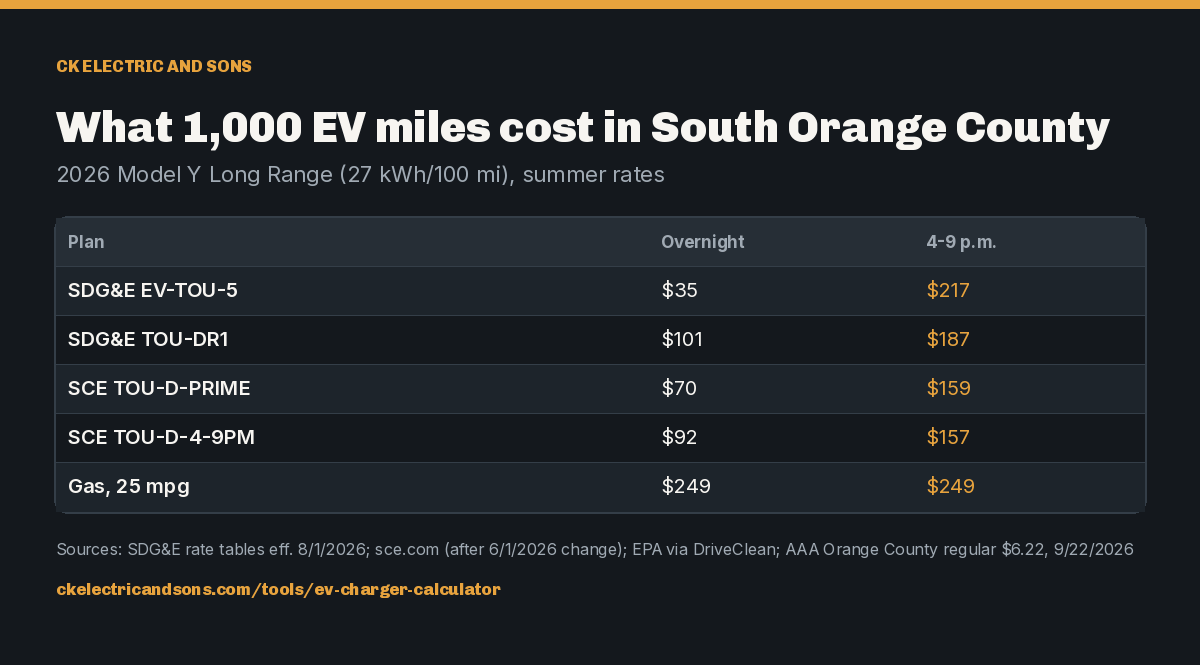
A 48-amp EV charger needs a 60-amp breaker and 6 AWG copper THHN in conduit (4 AWG if it’s NM-B cable), and it adds about 43 miles of range an hour to a Tesla Model Y Long Range. Charging overnight on SDG&E’s EV-TOU-5 costs 13.1¢/kWh this summer, about $35 a month for 1,000 miles, against about $249 for gas at 25 mpg.
Your car, charger and rate
What you need and what it costs
- Rate used
- 13.1¢/kWh · Super off-peak, midnight–6 a.m., summer
- Prices as of
- SDG&E total rates table effective Aug 1, 2026
- Energy for 0–100%
- 88.3 kWh from the wall
- Cost per 100 miles
- $3.53 electric vs $24.90 gas
- Monthly difference
- $214 less than gas
Power: min(48 A charger, 48 A car) × 240 V = 11.52 kW.
Range per hour: 11.52 kW ÷ 0.270 kWh/mi = 42.7 mi.
20→80%: 60% × 327 mi × 0.270 kWh/mi = 53.0 kWh ÷ 11.52 kW = 4 h 36 min; × $0.13090 = $6.93.
Month: 1,000 mi × 0.270 = 270.0 kWh × $0.13090 = $35.34. Gas: 1,000 ÷ 25 mpg × $6.2247 = $248.99.
EPA kWh/100 mi is measured at the wall, so charging losses are already counted (DOE puts them near 16%, so about 44.5 kWh of that 20→80% session reaches the battery). Costs are energy charges only: the $0.79/day Base Services Charge is on the bill with or without an EV. Wire sizes are copper before any temperature, bundling or long-run voltage-drop corrections, with 75 °C terminations for THHN. Gas: AAA Orange County average, regular, 2026-09-22. The inspector and your city’s adopted code have the final word.
A Model Y on a 48 A charger in an SDG&E garage
Take a 2026 Tesla Model Y Long Range AWD (EPA: 327 miles, 27 kWh per 100 miles) on a Wall Connector set to 48 A at 240 V, charging after midnight on SDG&E EV-TOU-5 in summer, driving 1,000 miles a month.
- Circuit: 48 A × 125% = 60 A breaker. Wire has to carry 60 A: 6 AWG copper THHN (65 A at 75 °C) or 4 AWG NM-B (70 A at 60 °C; 6 AWG NM-B is only 55 A).
- Power: 48 A × 240 V = 11.52 kW. Range per hour: 11.52 ÷ 0.27 kWh/mi = 42.7 miles (Tesla’s own table says 44).
- 20% to 80%: 0.60 × 327 mi × 0.27 = 53.0 kWh from the wall, ÷ 11.52 kW = 4 h 36 min, at $0.13090 = $6.93.
- A month: 1,000 mi × 0.27 = 270 kWh × $0.13090 = $35.34. The same miles in a 25 mpg car: 40 gallons × $6.2247 = $248.99.
The same car on SCE’s TOU-D-PRIME, charging overnight in summer at 26¢, runs about $70 a month. Charge between 4 and 9 p.m. on EV-TOU-5 instead and the SDG&E bill for those miles jumps to about $217, so set the charging schedule to start after midnight.
Charger amps, breaker, wire and range per hour
Every row applies the continuous-load rule: breaker and wire at 125% of the charger setting. Copper conductors, 75 °C column for THHN/THWN-2 in conduit, 60 °C column for NM-B. Range per hour at 240 V assumes 3.5 mi/kWh (about 28.6 kWh/100 mi, close to the EPA rating of a Model Y Long Range, BMW i4 or VW ID.4 Pro).
| Charger | Breaker | THHN in conduit | NM-B cable | kW at 240 V | Miles per hour |
|---|---|---|---|---|---|
| 16 A | 20 A | 12 AWG | 12 AWG | 3.84 | 13 |
| 24 A | 30 A | 10 AWG | 10 AWG | 5.76 | 20 |
| 32 A | 40 A | 8 AWG | 8 AWG | 7.68 | 27 |
| 40 A | 50 A | 8 AWG | 6 AWG | 9.60 | 34 |
| 48 A | 60 A | 6 AWG | 4 AWG | 11.52 | 40 |
| 64 A | 80 A | 4 AWG | 3 AWG | 15.36 | 54 |
| 80 A | 100 A | 3 AWG | Use THHN | 19.20 | 67 |
64 A and 80 A settings only help a car with a roughly 19 kW onboard charger, like the Silverado EV listed above. At 208 V every kW figure drops by about 13%.
| Plan | When | Hours | Summer | Winter |
|---|---|---|---|---|
| SDG&E EV-TOU-5 | Super off-peak | midnight–6 a.m. | $3.74 | $3.52 |
| SDG&E EV-TOU-5 | Super off-peak | 10 a.m.–2 p.m. weekdays | $3.74 | $3.52 |
| SDG&E EV-TOU-5 | On-peak | 4–9 p.m. daily | $22.92 | $14.97 |
| SDG&E TOU-DR1 | Super off-peak | midnight–6 a.m. | $10.70 | $12.49 |
| SDG&E TOU-DR1 | Super off-peak | 10 a.m.–2 p.m. weekdays | $10.70 | $12.49 |
| SDG&E TOU-DR1 | On-peak | 4–9 p.m. daily | $19.75 | $17.56 |
| SCE TOU-D-PRIME | Off-peak | 9 p.m.–8 a.m. (summer: all hours outside 4–9 p.m.) | $7.43 | $6.86 |
| SCE TOU-D-PRIME | Off-peak / super off-peak | 8 a.m.–4 p.m. | $7.43 | $6.86 |
| SCE TOU-D-PRIME | On-peak / mid-peak | 4–9 p.m. weekdays | $16.86 | $16.00 |
| SCE TOU-D-4-9PM | Off-peak | 9 p.m.–8 a.m. | $9.71 | $10.57 |
| SCE TOU-D-4-9PM | Off-peak / super off-peak | 8 a.m.–4 p.m. | $9.71 | $9.43 |
| SCE TOU-D-4-9PM | On-peak / mid-peak | 4–9 p.m. weekdays | $16.57 | $14.57 |
| Gasoline, 25 mpg | Any time | AAA Orange County average, regular, 2026-09-22 | $24.90 | $24.90 |
SDG&E prices effective August 1, 2026 (summer June 1 to October 31). SCE prices as published on sce.com, rounded to the cent, after SCE’s June 1, 2026 change (summer June to September). Energy charges only; both utilities add a Base Services Charge of about $0.79 a day whether or not you own an EV.
In 4 steps
- Pick your car, or choose "Other" and type the max AC charge rate, EPA range and kWh/100 mi from your manual or window sticker.
- Choose a charger setting. The tool shows the breaker and the smallest copper wire for it.
- Pick your utility plan, when you charge and the season. Not sure if you’re SDG&E or SCE? Use the utility finder.
- Enter your monthly miles and the mpg of the car you would otherwise drive to see the gas comparison.
Why the breaker is bigger than the charger
The code treats an EV charger as a continuous load, so the breaker has to be at least 125% of the charger’s rating (2023 NEC 625.41 and 625.42). That’s why a 48 A Wall Connector sits on a 60 A breaker and a 40 A charger on a 50 A breaker. The wire gets the same 125% treatment. NM-B cable is held to its 60 °C rating (334.80), which is why it runs a size bigger than THHN at 40 A and up.
A plug-in charger on a NEMA 14-50 outlet is on a 50 A circuit, so it can’t be set above 40 A, and under the 2023 NEC that receptacle needs GFCI protection (625.54). California’s current electrical code, the 2025 California Electrical Code, is built on the 2023 NEC and took effect January 1, 2026.
Two EVs don’t automatically mean two big circuits. An energy management system can cap the total, and the code lets the load calculation use that setpoint (625.42 and 220.70). Tesla’s Gen 3 Wall Connectors can share one network limit across up to six units. We install chargers and pull the permits across South Orange County; see EV charger installation.
EV charger calculator: common questions
What size breaker do I need for a 48 amp EV charger?
A 60 amp breaker. EV chargers are continuous loads, so the breaker has to be at least 125% of the charger setting (48 x 1.25 = 60). The wire needs a 60 amp rating too: 6 AWG copper THHN in conduit, or 4 AWG if it is NM-B cable.
Can I use a NEMA 14-50 outlet for my EV?
Yes, but a charger plugged into a 14-50 is limited to 40 amps because the outlet is on a 50 amp circuit. Under the 2023 NEC, receptacles installed for EV charging need GFCI protection. Above 40 amps the charger has to be hardwired.
How much does it cost to charge an EV on SDG&E?
On EV-TOU-5 overnight (midnight to 6 a.m.) it is 13.090 cents per kWh in summer and 12.332 cents in winter as of August 1, 2026. For a car using 27 kWh per 100 miles that is about $35 for 1,000 miles. Charging from 4 to 9 p.m. costs 80.205 cents in summer.
How much does it cost to charge an EV on SCE?
On TOU-D-PRIME, overnight charging is 26 cents per kWh in summer and 24 cents in winter, as SCE publishes it after its June 1, 2026 rate change. That is about $70 for 1,000 miles in a car using 27 kWh per 100 miles. Weekday 4 to 9 p.m. is 59 cents in summer.
Do I need a 64 or 80 amp charger?
Only if your car has an onboard charger around 19 kW, like the Chevrolet Silverado EV with the 19 kW charger. The Teslas, Kia EV9 and VW ID.4 in this tool top out at 11.5 kW (48 amps) or less, so a bigger setting will not charge them any faster. An 80 amp charger needs a 100 amp circuit.
Is the charging cost in the EPA numbers or do I add losses?
EPA kWh per 100 miles and MPGe are measured from the wall, so charging losses are already included. DOE puts the wall-to-battery loss near 16%, which is why the kWh you pay for is more than the kWh that land in the battery.
Where these numbers come from
- Mike Holt — 2023 NEC Article 625, Electric Vehicle Power Transfer System625.40 individual branch circuit, 625.41 breaker at least 125% of the EVSE rating (40 A EVSE -> 50 A), 625.42 EVSE is a continuous load and energy management, 625.54 GFCI on EV receptacles (read Sep 22, 2026).
- Mike Holt — 2023 NEC 220.70, Energy Management SystemsAn EMS setpoint can be used in the service/feeder load calculation (read Sep 22, 2026).
- California Building Standards Commission — 2025 Title 24 code changes2025 Title 24 published July 1, 2025, effective January 1, 2026; Part 3 references the 2023 NEC (read Sep 22, 2026).
- Cerrowire — copper ampacity chartCopper ampacities at 60 °C and 75 °C, 12 AWG through 1/0 (read Sep 22, 2026).
- EC&M — Sizing Conductors, Part VIII334.80: NM cable ampacity may not exceed a 60 °C conductor (read Sep 22, 2026; article written to an earlier NEC edition).
- EC&M — Sizing Conductors, Part XXI210.19(A)(1) continuous load x 125%, 240.4(D) 12 AWG max 20 A, 110.14(C) 75 °C terminations (read Sep 22, 2026; earlier-edition article).
- Tesla — Wall Connector support pageBreaker/output pairs (60/48, 50/40, 40/32, 30/24, 20/16 A), 11.5 kW max, Model 3/Y RWD and Model Y AWD capped at 32 A (read Sep 22, 2026).
- Tesla — Wall Connector power sharingUp to six Gen 3 Wall Connectors can share power; no internet connection required (read Sep 22, 2026).
- Tesla — Gen 3 Wall Connector installation manual, power sharing setupOne leader plus five followers; installer programs a network current limit (read Sep 22, 2026).
- DriveClean (California Air Resources Board) — Tesla vehicles2026 Model 3, Model Y, Model S and Cybertruck EPA range and combined kWh/100 mi (read Sep 22, 2026).
- DriveClean — Model Y Long Range AWD2026: 327 mi, 27 kWh/100 mi (read Sep 22, 2026).
- DriveClean — Model X2026: 352 mi, 32 kWh/100 mi (read Sep 22, 2026).
- DriveClean — Rivian2026 R1S Dual Large (20 in): 300 mi, 42 kWh/100 mi (read Sep 22, 2026).
- DriveClean — F-150 Lightning 4WD Extended Range2024: 320 mi, 47 kWh/100 mi (read Sep 22, 2026).
- DriveClean — BMW i4 eDrive40 (18 in)2026: 333 mi, 28 kWh/100 mi (read Sep 22, 2026).
- DriveClean — VW ID.4 Pro2025: 291 mi, 29 kWh/100 mi (read Sep 22, 2026).
- DriveClean — 2026 Chevrolet Silverado EV, 24-module battery, 19kW charger49 kWh/100 mi combined; onboard charger named in the EPA listing (read Sep 22, 2026).
- Chevrolet — 2026 Silverado EV"Up to 478 miles" (GM-estimated) and 24-41 miles per hour on Level 2 (read Sep 22, 2026).
- Kia — 2026 EV9 specifications10.9 kW onboard charger; Wind AWD 283 mi EPA, 84 MPGe combined (read Sep 22, 2026).
- Volkswagen — 2026 ID.4ID.4 Pro 291 mi EPA; AC charging up to 11 kW (read Sep 22, 2026).
- EPA — Fuel Economy and EV Range Testing33.7 kWh = 1 gallon; EPA MPGe includes charging losses (measured from the wall) (read Sep 22, 2026).
- U.S. DOE — Fact of the Week #1045About 16% energy loss from the wall to the battery during charging (2018 figure, read Sep 22, 2026).
- SDG&E — Schedule EV-TOU-5 total rates, effective 8/1/2026Summer 80.205 / 49.627 / 13.090 ¢; winter 52.383 / 46.566 / 12.332 ¢ (on / off / super off-peak); Base Services Charge $0.79343/day (read Sep 22, 2026).
- SDG&E — Schedule TOU-DR1 total rates, effective 8/1/2026Summer 69.135 / 46.421 / 37.433 ¢; winter 61.471 / 53.060 / 43.719 ¢; baseline credit 10.702 ¢ up to 130% of baseline (read Sep 22, 2026).
- SDG&E — Electric vehicle pricing plansEV-TOU-5 hours: super off-peak midnight-6 a.m. and 10 a.m.-2 p.m. weekdays, midnight-2 p.m. weekends; on-peak 4-9 p.m. (read Sep 22, 2026).
- SDG&E — Pricing plans (TOU-DR1 hours)TOU-DR1 uses the same periods as EV-TOU-5; prices effective Aug 1, 2026 (read Sep 22, 2026).
- SDG&E — Baseline allowance calculatorSummer June 1-October 31, winter November 1-May 31 (read Sep 22, 2026).
- SDG&E — Base Services ChargeAbout $24/month standard, $12 FERA, $6 CARE, on bills since October 2025 under AB 205 (read Sep 22, 2026).
- SCE — Time-of-use residential rate plansTOU-D-4-9PM and TOU-D-PRIME cents per kWh by season and period; Base Services Charge $0.79/day; summer June-September (read Sep 22, 2026).
- SCE — Electric vehicle rate plans (TOU-D-PRIME)Eligibility (EV or plug-in hybrid, home battery, or electric heat pump) and period hours (read Sep 22, 2026).
- SCE — Rates advisoryMost recent residential rate change took effect June 1, 2026 (read Sep 22, 2026).
- AAA — California gas pricesOrange County average regular $6.2247 on 9/22/26 (read Sep 22, 2026).
- U.S. DOE Alternative Fuels Data Center — charging stationsLevel 2 runs 208 V (commercial) or 240 V (residential), 2.9-19.2 kW (read Sep 22, 2026).
Last reviewed . This tool is general information for planning, not a design or a permit document — your inspector and the code edition your city has adopted have the final word. Spot something wrong? Text Shane at (949) 702-0385 and it gets fixed.
Rather have a licensed electrician look at it?
Text Shane a photo of your panel or the problem. Photo quotes by text are free.
CSLB #354550 · C-10 Electrical · Licensed since 1978 · $25,000 contractor's bond