Solar-ready panel checker (the 120% rule)
A panel with a 200 A busbar and a 200 A main can take a 40 A solar or battery breaker, which works out to 32 A of inverter output, about 7.7 kW AC. That’s the 120% rule in 2023 NEC 705.12(B)(2): 1.25 × the inverter’s continuous current plus the main breaker can’t exceed 1.2 × the busbar rating, and the solar breaker goes at the far end from the main.
Your panel and your system
What your panel can take
Limit: 1.2 × 200 A = 240 A
Room after the 200 A main: 240 − 200 = 40 A
Max new source current: 40 ÷ 1.25 = 32 A ≈ 7.68 kW at 240 V
Your system: 1.25 × 48 A + 200 A = 260 A vs 240 A over
- Derate the main breaker
- 175 A main
- Bigger busbar, same main
- 225 A busbar
- Supply-side connection
- Skips the busbar math (705.11)
Whole-home battery backup often adds a gateway or meter-collar switch ahead of the panel, which changes which busbar this check applies to. Read labels only. Don’t remove the panel cover. A hot panel, a burning smell or scorch marks: shut off the main and call an electrician.
A Powerwall 3 on a 200 A panel
A Powerwall 3 set to 11.5 kW puts out 48 A continuous, per Tesla’s datasheet. On a panel with a 200 A busbar and a 200 A main:
1.25 × 48 A + 200 A = 260 A, against a limit of 1.2 × 200 A = 240 A. It’s over by 20 A, so it doesn’t fit as-is.
Three ways it can work:
- Derate the main to 175 A. 1.25 × 48 + 175 = 235 A, under 240. Only if the house’s load calculation still passes at 175 A.
- Set the Powerwall to 7.6 kW. That’s 31.7 A: 1.25 × 31.7 + 200 = 239.6 A. It just fits, on a 40 A breaker.
- Swap to a panel with a 225 A busbar and keep the 200 A main. 260 A against 1.2 × 225 = 270 A. That fits with room to spare.
A supply-side connection is the fourth route. It lands between the meter and the main, so the busbar math doesn’t apply at all.
Max backfeed breaker by busbar and main
120% rule, solar breaker at the opposite end from the main, nothing else already backfeeding the panel. kW is AC output at 240 V. Where the room left isn’t a standard breaker size, the breaker rounds down, and the last column shows what that breaker supports.
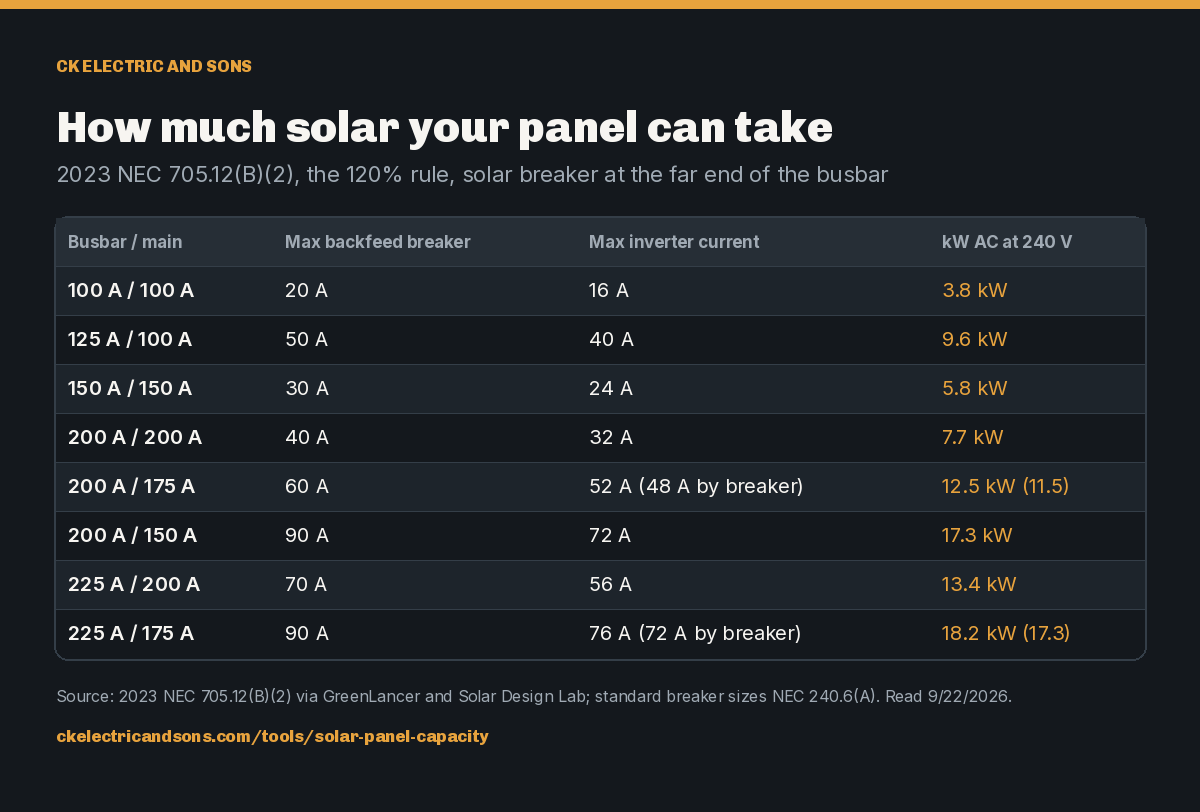
| Busbar / main | 1.2 × busbar | Room left | Max backfeed breaker | Max inverter current | ≈ kW AC | By breaker size |
|---|---|---|---|---|---|---|
| 100 A / 100 A | 120 A | 20 A | 20 A | 16 A | 3.84 kW | Same |
| 125 A / 100 A | 150 A | 50 A | 50 A | 40 A | 9.6 kW | Same |
| 150 A / 150 A | 180 A | 30 A | 30 A | 24 A | 5.76 kW | Same |
| 200 A / 200 A | 240 A | 40 A | 40 A | 32 A | 7.68 kW | Same |
| 200 A / 175 A | 240 A | 65 A | 60 A | 52 A | 12.48 kW | 48 A (11.52 kW) |
| 200 A / 150 A | 240 A | 90 A | 90 A | 72 A | 17.28 kW | Same |
| 225 A / 200 A | 270 A | 70 A | 70 A | 56 A | 13.44 kW | Same |
| 225 A / 175 A | 270 A | 95 A | 90 A | 76 A | 18.24 kW | 72 A (17.28 kW) |
In 5 steps
- Find the busbar rating on the panel label, usually on the inside of the door. The main breaker rating is stamped on its handle.
- Note whether the main sits at the top or bottom of the breaker rows (end-fed) or in the middle (center-fed).
- Add any solar or battery already connected, in kW AC from the inverter label or your utility approval letter.
- Pick your battery or enter the inverter size, or choose "Tell me the max" to see the ceiling.
- If it doesn’t fit, compare the derate, bigger busbar and supply-side options, and run the panel load calculator before counting on a derate.
Why the busbar is the limit
The busbar is the metal strip the breakers clip onto. The main breaker protects it from the utility side, but a solar inverter or battery feeds it from the other end, and the main can’t see that current. The NEC lets the busbar carry up to 120% of its rating only when the two sources sit at opposite ends, so the current spreads along the bar instead of piling up in one spot. That breaker gets a permanent “do not relocate” label.
If the solar breaker can’t go at the far end, the 100% rule in 705.12(B)(1) applies instead, and a panel whose busbar matches its main (200 A / 200 A) has no room at all. A third option, 705.12(B)(3), adds up every breaker in the panel except the main. It rarely passes in a house, because branch breakers usually add up to more than the busbar. Center-fed panels in homes get the 120% math with the connection at one end, not both (705.12(B)(4)).
Derate, upgrade or tap
A main-breaker derate swaps the main for a smaller one, say 200 A down to 175 A, which frees 25 A of busbar. It’s the cheapest fix on paper, but the house then has a smaller service, so the load calculation has to support it, and a one-family house can’t go below 100 A. A new panel with a busbar bigger than its main (225 A busbar, 200 A main) keeps the full service and adds room. A supply-side connection under 705.11 skips the busbar entirely; on a combined meter-main, anything in the utility’s sealed section needs the utility’s sign-off.
Batteries count the same as solar
To the busbar, a battery inverter is just another source. Use its continuous AC output current from the spec sheet, not its peak. Whole-home backup setups, like Powerwall 3 with Backup Gateway 3 or a Backup Switch, put equipment between the meter and the panel, which can move the connection point. The installer’s one-line diagram shows which busbar the check applies to. We do this electrical side alongside the solar installer; see solar-ready panels and battery backup.
California’s 2025 Electrical Code, effective January 1, 2026, is built on the 2023 NEC. Your inspector and your city’s adopted edition have the final word.
Solar panel capacity: common questions
What is the 120% rule for solar?
It lets a panel busbar carry up to 120% of its rating when the solar breaker sits at the opposite end from the main. The math in 2023 NEC 705.12(B)(2) is 1.25 × inverter continuous current + main breaker ≤ 1.2 × busbar rating. On a 200 A busbar with a 200 A main, that leaves room for a 40 A backfeed breaker.
How big a solar system can a 200 amp panel handle?
With a 200 A busbar and a 200 A main, the 120% rule allows 32 A of continuous inverter output, about 7.7 kW AC at 240 V. A 225 A busbar with the same 200 A main allows 56 A, about 13.4 kW AC.
Is a main breaker derate safe?
It’s code-compliant when the house’s load calculation supports the smaller main. A 200 A to 175 A derate frees 25 A of busbar room. If the load calculation says the house needs the full 200 A, a derate means nuisance trips, and a panel upgrade or supply-side connection is the better route.
Does a home battery count against the 120% rule?
Yes. A battery inverter backfeeds the busbar like a solar inverter does, so its continuous output current goes into the same math. A Powerwall 3 at its 11.5 kW setting is 48 A, which needs a 60 A breaker and does not fit a 200 A / 200 A panel without a derate, a lower setting, or a different connection.
Where do I find my busbar rating?
On the panel label, usually a sticker on the inside of the door, listed as the bus or panel rating in amps. The main breaker’s rating is stamped on its handle. Read them with the door open and the cover on. Never remove the dead-front cover to look.
Where these numbers come from
- California Building Standards Commission: 2025 California Electrical Code, Initial Statement of Reasons (Part 3)The 2025 CEC brings "the 2023 NEC" into California's code (read Sep 22, 2026).
- California Building Standards Commission: Codes2025 Title 24 published July 1, 2025, effective January 1, 2026 (read Sep 22, 2026).
- GreenLancer: The 120% Rule for Solar (NEC 705.12)2023 NEC numbering (120% rule at 705.12(B)(2), center-fed at 705.12(B)(4)), the 100% and sum-of-breakers options, and the 200 A / 200 A → 40 A → 32 A example (read Sep 22, 2026).
- Solar Design Lab: Solar 120% Rule, NEC 705.12 GuideWarning label text for the 120% option, the 225 A / 200 A → 70 A / 56 A row, and that a derate only works if the Article 220 load calculation supports the smaller main (read Sep 22, 2026).
- Mayfield Renewables: Code Corner, 2020 NEC 705.12(B)(3)(1) and (2)Background on the 100% and 120% busbar options as numbered in the 2020 edition, before the 2023 renumbering (read Sep 22, 2026).
- Solar Builder: NEC 2020 705.11 Load and Supply Side ConnectionsSupply-side connections as the option when the load-side math fails, and that equipment under the utility's exclusive control only takes connections the utility approves (read Sep 22, 2026).
- Callout: NEC 2023 240.6 Standard Ampere RatingsStandard breaker sizes used to round backfeed breakers and derated mains (read Sep 22, 2026).
- EC&M: Services and the NEC, Part 2230.79: a one-family dwelling service disconnect must be at least 100 A, the floor for any derate (read Sep 22, 2026).
- Tesla: Powerwall 3 Datasheet (2025, US)Output settings of 5.8, 7.6, 10 and 11.5 kW with 24, 31.7, 41.7 and 48 A max continuous current and 30, 40, 60 and 60 A overcurrent devices; whole-home backup through Backup Gateway 3 or Backup Switch (read Sep 22, 2026).
- Enphase: IQ Battery 5P data sheet3.84 kVA rated continuous output at 240 VAC per battery (read Sep 22, 2026).
Last reviewed . This tool is general information for planning, not a design or a permit document — your inspector and the code edition your city has adopted have the final word. Spot something wrong? Text Shane at (949) 702-0385 and it gets fixed.
Rather have a licensed electrician look at it?
Text Shane a photo of your panel or the problem. Photo quotes by text are free.
CSLB #354550 · C-10 Electrical · Licensed since 1978 · $25,000 contractor's bond