Can my panel handle it? Home load calculator
An existing house’s load under NEC 220.83 is 3 VA per square foot, plus 1,500 VA for each kitchen and laundry circuit, plus every electric appliance’s nameplate, with the first 8,000 VA counted in full and the rest at 40 %, divided by 240 V. If that stays at or under the main breaker’s rating, the new load fits: a 2,000 ft² house with gas cooking and a gas dryer adding a 48 A EV charger comes to 74.2 A.
Your house
Examples to start from, not data about any real house. Change anything.
Swapping out an electric appliance? Untick the old one above so it isn’t counted twice.
Result
A planning estimate from the 2023 NEC methods in the 2025 California Electrical Code. The permit set needs your electrician’s calculation, and your city’s inspector has the final word. Appliance watts left at the defaults come from published typical ranges; the nameplate on your own appliance is better.
A 2,000 ft² house adding a 48 A EV charger
The house: 2,000 ft², a gas range, gas dryer and gas water heater, central air conditioning, a dishwasher, disposal and built-in microwave, the code-minimum three 20 A kitchen and laundry circuits, and a 200 A service. The owner wants a charger that delivers 48 A on a 60 A breaker. No air conditioning or electric heat is being added, so 220.83(A) applies.
That leaves 125.8 A of room on a 200 A service. Some California building departments enter the charger at 125 % outside the 40 % step instead (Campbell’s worksheet does). Read that way the house calculates at 115.0 A, which still fits.
Put the same house on a 100 A service and the code-text answer doesn’t change: 74.2 A, it fits. The stricter reading gives 115.0 A, over the rating. Under that reading the biggest charger that fits with no load management is 32 A on a 40 A breaker (95.0 A). That’s the whole argument for asking your building department which reading it uses before anyone quotes a service upgrade.
The 220.87 route skips the appliance list. Suppose (a made-up number for illustration) the highest 15-minute demand in the utility download were 5 kW: 5,000 VA × 125 % = 6,250 VA, plus the charger at 125 % (11,520 VA × 1.25 = 14,400 VA) = 20,650 VA, or 86.0 A on a 100 A service.
Common appliance loads, and what an EV charger adds
Use the nameplate on your own appliance when you can. These are the published values the calculator starts from, each with its source. Gas appliances don’t count in a load calculation.
| Appliance | Load used | Basis | Source |
|---|---|---|---|
| EV charger, 48 A (60 A breaker) | 11,520 VA | 48 A × 240 V; manual lists 11.5 kW | Tesla Wall Connector manual |
| EV charger, 40 A (50 A breaker) | 9,600 VA | 40 A × 240 V; manual lists 9.6 kW | Tesla Wall Connector manual |
| EV charger, 32 A (40 A breaker) | 7,680 VA | 32 A × 240 V; manual lists 7.6 kW | Tesla Wall Connector manual |
| Heat pump, 3-ton ducted | 6,600 VA | 5,760 W heat pump + 840 W air handler | Redwood Energy all-electric retrofit guide |
| Central air conditioner | 6,000 VA | worksheet value for central heating/AC | CA Office of Planning & Research EV load worksheet |
| Electric furnace / resistance heat | 8,000 VA | worksheet value for a central electric furnace | CA Office of Planning & Research EV load worksheet |
| Induction cooktop, 36 in. | 8,900 VA | spec sheet 8.9 kW at 240 V / 40 A | Samsung CC70F36S2D spec sheet |
| Electric clothes dryer | 5,000 VA | top of the 1,800–5,000 W typical range | Virginia Cooperative Extension / DOE |
| Electric tank water heater (40 gal) | 5,500 VA | top of the 4,500–5,500 W typical range | Virginia Cooperative Extension / DOE |
| Heat pump water heater, 120 V plug-in | 900 VA | 900 W, shares a circuit | Redwood Energy all-electric retrofit guide |
| Dishwasher | 2,400 VA | top of the 1,200–2,400 W typical range | Virginia Cooperative Extension / DOE |
| Microwave (built-in) | 1,100 VA | top of the 750–1,100 W typical range | Virginia Cooperative Extension / DOE |
| Garbage disposal | 1,000 VA | worksheet value | CA Office of Planning & Research EV load worksheet |
| Pool or spa equipment | 3,500 VA | worksheet value | CA Office of Planning & Research EV load worksheet |
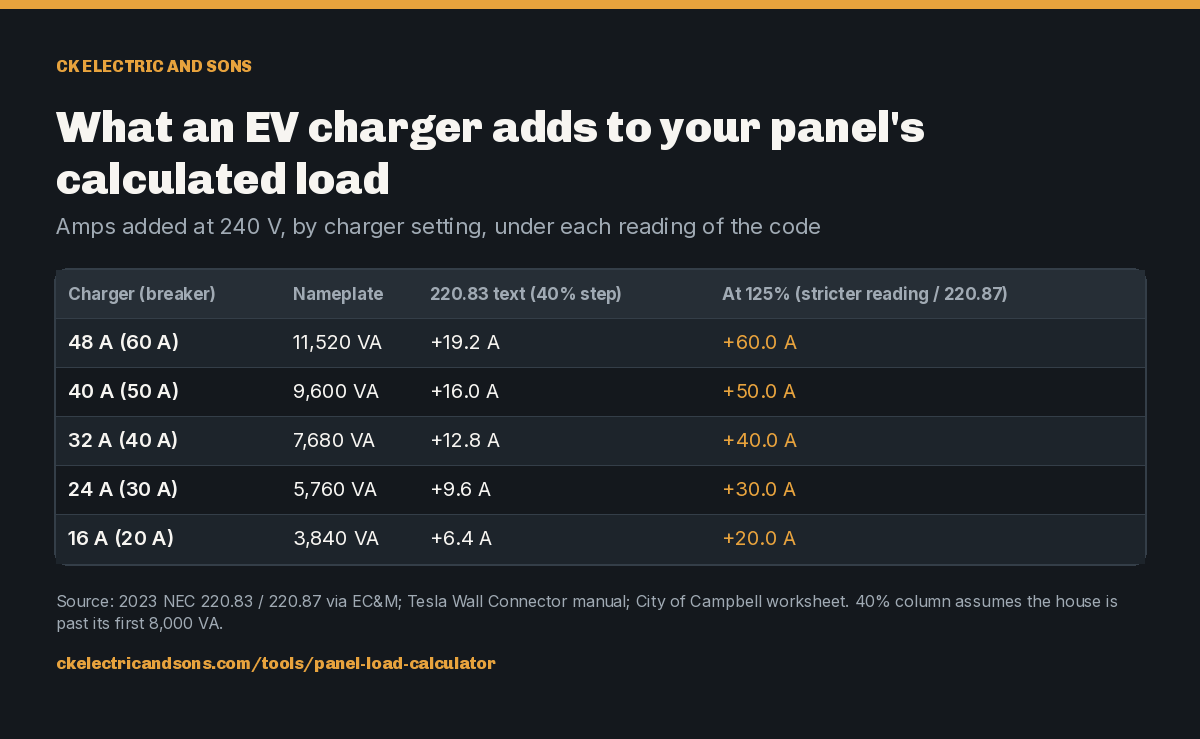
| Charging setting | Nameplate | 220.83 text (40 % step) | At 125 % (stricter 220.83 reading, and 220.87) |
|---|---|---|---|
| 48 A (60 A breaker) | 11,520 VA | +19.2 A | +60.0 A |
| 40 A (50 A breaker) | 9,600 VA | +16.0 A | +50.0 A |
| 32 A (40 A breaker) | 7,680 VA | +12.8 A | +40.0 A |
| 24 A (30 A breaker) | 5,760 VA | +9.6 A | +30.0 A |
| 16 A (20 A breaker) | 3,840 VA | +6.4 A | +20.0 A |
The 40 % column assumes the house is already past the first 8,000 VA, which any house with a kitchen is.
In 5 steps
- Read the number on your main breaker handle (100, 125, 150, 200 A). Look only; the panel door is fine to open, the cover behind it isn’t.
- Pick a method: list your appliances (220.83), or use your SDG&E or SCE Green Button download (220.87).
- For 220.83, enter your living area and tick every electric appliance you already have. Swap in nameplate watts where you know them.
- Add what you’re planning: the charger setting, a heat pump, an induction range, an ADU’s floor area.
- Read the verdict and the arithmetic. If it says load management, the biggest charger setting that fits is listed under it.
Why two methods, and why the answers differ
220.83 is an estimate built from the house’s parts. It assumes not everything’s running at once, which is why everything past the first 8,000 VA counts at 40 %. Adding air conditioning or electric heat changes the math: under 220.83(B) the larger of the two goes in at 100 %, since A/C and heat run for hours at a stretch.
220.87 measures instead of estimating. It takes the highest 15-minute demand from a year of utility data, adds 25 % margin, then adds the new load. Your SDG&E or SCE smart meter’s already recording it. The catch: with solar or a battery the meter sees the net flow, and the code’s 30-day recording fallback isn’t allowed with solar at all.
When the numbers come out close, load management is the middle path. NEC 625.42 lets an energy management system throttle an EV charger, and 220.70 lets a system that caps the whole service be calculated at its setpoint. Circuit-sharing devices that keep, say, the dryer and the charger from running together work the same way. We handle the calculation, the permit and the utility side when a panel upgrade is the real answer.
Panel load calculator: common questions
Can a 100 amp panel handle an EV charger?
Often, yes. In the worked example a 2,000 ft² gas-cooking house with central air comes to 74.2 A with a 48 A charger under the NEC 220.83 text. Building departments that count the charger at 125 % get 115.0 A, and then a 32 A charger or load management fits where 48 A doesn't.
What is the 40 percent rule in a load calculation?
NEC 220.83 counts the first 8,000 VA of an existing house’s load at 100 % and everything above it at 40 %, because a house rarely runs every appliance at once. Air conditioning or electric heat being added is the exception: under 220.83(B) the larger of the two goes in at 100 %.
Where do I find my peak demand for the 220.87 method?
Download your Green Button data. On SDG&E it’s My Energy Center, then Usage, then Green Button Download below the graph. On SCE it’s the Green Button Download in the Energy Management Center after you sign in. Find the largest interval reading; a 15-minute kWh value times 4 is kW.
Does a heat pump count differently from an EV charger?
Yes. A heat pump adds both air conditioning and electric heat, so NEC 220.83(B) applies and its nameplate goes in at 100 % instead of 40 %. A published 3-ton example is 5,760 W plus an 840 W air handler, 6,600 VA in all. The charger stays in the 40 % step under the code text.
Is this calculator enough for a permit?
No. It’s a planning estimate. The permit needs a load calculation from the electrician doing the work, and the city inspector decides which method and which reading they accept under the 2025 California Electrical Code.
Where these numbers come from
- California Building Standards Commission — Codes (2025 Title 24)2025 California Building Standards Code published July 1, 2025, effective January 1, 2026; Part 3 is the California Electrical Code (read Sep 22, 2026).
- HCAI Initial Statement of Reasons, 2025 California Electrical Code (Part 3)The 2025 CEC repeals the 2020 NEC and adopts the 2023 NEC (read Sep 22, 2026).
- Electrical Contractor — Branch-Circuit, Feeder and Service Calculations, Part LII220.83 line items (3 VA/ft², 1,500 VA circuits, nameplates), first 8 kVA at 100 % and the rest at 40 %, A/C or heat at 100 % under (B); worked example 39,432 VA → 20,573 VA, plus 7,200 VA of A/C → 27,773 VA. Used for the tests (read Sep 22, 2026).
- Mike Holt Forum — public input on NEC 220.83Quotes the current 220.83(A)/(B) headings: whether air-conditioning or electric space-heating equipment "is to be installed" (read Sep 22, 2026).
- City of Campbell, CA — Electrical Load Calculation worksheet (2022)A California building department worksheet: existing dwelling 8,000 W at 100 %, balance at 40 %; larger of A/C or heat, not both; a Level 2 EV charger entered at 125 % (7.7 kVA → 9,625 W). Basis of the "stricter reading" line (read Sep 22, 2026).
- Electrical Contractor — Mark C. Ode, "When a Local Requirement Went National" (May 14, 2024)220.87: one year of maximum-demand data, × 125 % plus the new load; 30-day recording (highest 15-minute average kW) only when a year is not available, and not with solar, wind or peak shaving (read Sep 22, 2026).
- Leviton Captain Code (2023 NEC) — 220.70 Energy Management SystemsAn EMS limiting a service per 750.30 lets the load calculation use its maximum ampere setpoint, counted as continuous (read Sep 22, 2026).
- ExpertCE — How 2023 NEC changes affect EVSE load calculations625.42(A) energy management systems and 625.42(B) EV chargers with restricted-access adjustable settings (read Sep 22, 2026).
- Tesla Universal Wall Connector manual — circuit breaker rating / maximum output60 A breaker → 48 A (11.5 kW), 50 A → 40 A (9.6 kW), 40 A → 32 A (7.6 kW), 30 A → 24 A, 20 A → 16 A. Used as a manufacturer reference, not an endorsement (read Sep 22, 2026).
- Virginia Cooperative Extension 2901-9014, Estimating Appliance and Home Electronic Energy Use (DOE Building Science Community of Practice)Typical wattages: clothes dryer 1,800–5,000 W, 40-gal water heater 4,500–5,500 W, dishwasher 1,200–2,400 W, microwave 750–1,100 W; wattage is on the nameplate (read Sep 22, 2026).
- California Governor's Office of Planning & Research — Level 2 EV Charger Service Load CalculatorWorksheet values: central heating/AC 6,000 W, central electric furnace 8,000 W, garbage disposal 1,000 W, pool/spa 3,500 W (read Sep 22, 2026).
- Redwood Energy — A Pocket Guide to All-Electric Retrofits of Single-Family Homes3-ton heat pump 5,760 W + 840 W air handler; 120 V plug-in heat pump water heater 900 W; built-in induction ranges need at least a 40 A circuit; circuit-sharing devices (read Sep 22, 2026).
- Samsung CC70F36S2D 36-inch induction cooktop spec sheetTotal power 8.9 kW, 240 V / 40 A. One published nameplate used as the induction default (read Sep 22, 2026).
- SDG&E — Download My Green Button DataSteps: My Energy Center → Usage → Electric → Green Button Download → date range and format (read Sep 22, 2026).
- SDG&E — Download My Usage DataGreen Button lets customers download up to 13 months of electricity use (read Sep 22, 2026).
- SCE — Energy Management CenterGreen Button Download gives hourly and daily usage after signing in to My Account (read Sep 22, 2026).
Last reviewed . This tool is general information for planning, not a design or a permit document — your inspector and the code edition your city has adopted have the final word. Spot something wrong? Text Shane at (949) 702-0385 and it gets fixed.
Rather have a licensed electrician look at it?
Text Shane a photo of your panel or the problem. Photo quotes by text are free.
CSLB #354550 · C-10 Electrical · Licensed since 1978 · $25,000 contractor's bond