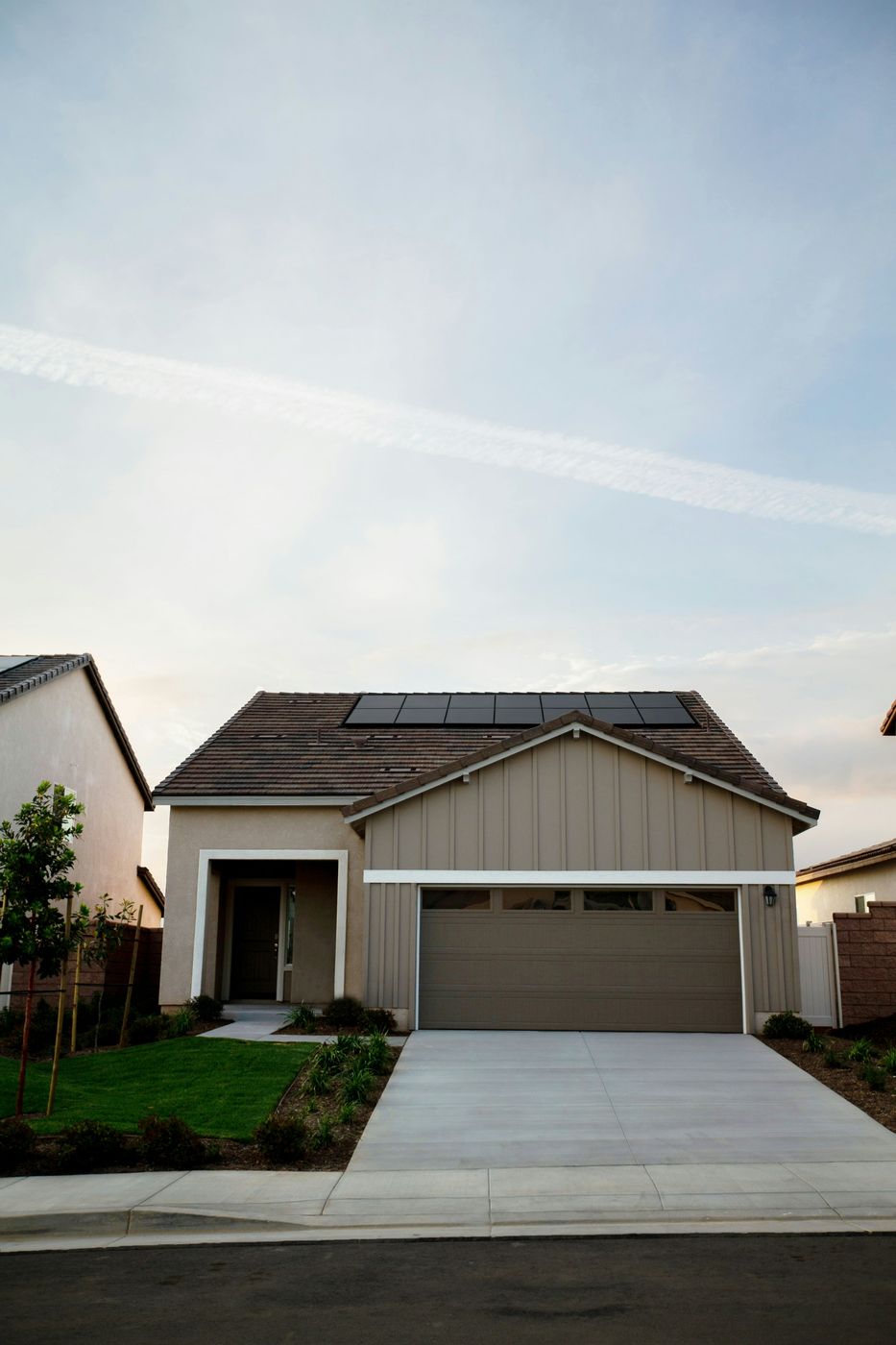
What does solar-ready mean for an existing house?
For an existing house, solar-ready comes down to one question: can the main panel accept a breaker that feeds power in, not just out? That depends on the busbar rating printed on the panel label, the main breaker’s size, and whether there’s a spot at the far end of the busbar for the new breaker. Service size matters too, because a battery and an EV charger often arrive in the same year.
New homes get a head start. California’s 2022 Energy Code made new single-family homes “ESS ready”: either equipment with at least 60 A of backed-up capacity feeding four or more branch circuits (the refrigerator, lighting near the main exit and a bedroom receptacle among them), or a 1-inch raceway from the main panel to a future subpanel. The main panel also needs a busbar of at least 225 A. None of it applies to additions or alterations, so a house that’s already standing gets checked on its own merits.
California’s current electrical code is the 2025 California Electrical Code, effective January 1, 2026, and it’s built on the 2023 NEC. That’s the edition the rules below come from.
How much solar can my panel take?
A standard 200 A panel with a 200 A main takes 32 A of continuous inverter output, which is 7.68 kW at 240 V. The limit comes from 2023 NEC 705.12(B)(2): 1.25 × the inverter’s continuous current plus the main breaker can’t exceed 120% of the busbar rating. The 120% allowance only applies when the solar breaker sits at the opposite end of the busbar from the main, and that breaker gets a permanent “do not relocate” label.
Put the breaker anywhere else and the stricter 100% rule applies, which leaves a 200 A / 200 A panel no room at all. Center-fed panels, with the main in the middle, get the 120% math with the connection at one end but not both.
120% rule, nothing else backfeeding the panel (2023 NEC 705.12(B)(2))| Busbar / main | Max backfeed breaker | Max inverter current | ≈ kW AC at 240 V |
|---|
| 100 A / 100 A | 20 A | 16 A | 3.8 kW |
|---|
| 125 A / 100 A | 50 A | 40 A | 9.6 kW |
|---|
| 150 A / 150 A | 30 A | 24 A | 5.8 kW |
|---|
| 200 A / 200 A | 40 A | 32 A | 7.7 kW |
|---|
| 200 A / 175 A | 60 A | 52 A | 12.5 kW |
|---|
| 225 A / 200 A | 70 A | 56 A | 13.4 kW |
|---|
One wrinkle in the 200 A / 175 A row: 65 A of room isn’t a standard breaker size, so the breaker rounds down to 60 A. The code math counts 125% of the inverter’s current and allows 52 A. If your plan checker goes by the breaker instead, plan on 48 A, which happens to be a Powerwall 3 at 11.5 kW.
The first thing that jumps out: a panel whose busbar is rated higher than its main has far more room. That’s why a 125 A busbar with a 100 A main takes more solar than a 150 A / 150 A panel. Run your own numbers in the solar panel capacity checker.
Derate, panel upgrade or supply-side tap: which fix?
When the system doesn’t fit, there are three standard ways out, and the house’s load decides which one works. A derate is the smallest job, a new panel is the biggest, and a supply-side tap depends on what your meter section allows.
Three ways to fit more solar or storage on an existing service| Fix | What changes | When it works | The catch |
|---|
| Main-breaker derate | Main swapped for a smaller one, like 200 A to 175 A, freeing 25 A of busbar | The load calculation passes at the smaller size | Less capacity for the house; can’t go below 100 A in a one-family home |
|---|
| New panel, bigger busbar | A 225 A busbar with the same 200 A main adds 30 A of room | The panel is old or full anyway | The biggest job of the three, with a utility disconnect and a permit |
|---|
| Supply-side connection (705.11) | Solar lands between the meter and the main, skipping the busbar math | There’s a legal place to make the tap | Anything in the utility’s sealed section needs the utility’s approval |
|---|
A derate looks free on paper, but it shrinks the service. If the load calculation needs the full 200 A, you’ll trade a solar problem for a tripping main. That’s the moment a panel upgrade earns its keep, especially on a 1970s or 80s panel that’s due anyway.
Whole-home or partial backup: what changes with a battery?
A battery counts against the busbar exactly like a solar inverter. Tesla’s Powerwall 3 can be set to 5.8, 7.6, 10 or 11.5 kW, which is 24, 31.7, 41.7 or 48 A of continuous output. At 11.5 kW it needs a 60 A breaker and doesn’t fit a 200 A / 200 A panel without help. Turned down to 7.6 kW, it fits on a 40 A breaker with a hair to spare.
Backup is a separate decision from capacity. Whole-home backup puts switching equipment between the meter and the panel; for Powerwall 3 that’s Backup Gateway 3 or the meter-mounted Backup Switch. Partial backup, through Backup Gateway 2 or a similar setup, moves the circuits that matter into a backup loads panel. That’s the fridge, lights, internet, a medical device and maybe the furnace blower, while the dryer and the oven wait for the grid.
Partial backup asks less of the battery, and it’s easier to size. The backup power sizing tool adds up running and starting watts and the kWh for a given outage length. South Orange County has a reason to care: SDG&E and SCE both run Public Safety Power Shutoffs during fire weather.
Why does a battery matter under the Net Billing Tariff?
Solar customers who applied to interconnect on or after April 15, 2023 are on the Net Billing Tariff, which the CPUC adopted on December 15, 2022 (D.22-12-056). Energy you send to the grid is credited at a value that reflects what it’s worth to the grid at that hour. The CPUC says that’s usually lower than the retail rate, though it can rise above retail on late summer evenings.
A battery changes the timing. Solar peaks at midday, and a battery holds some of that energy for the evening, when the CPUC says export values can climb and the house would otherwise be buying power back. Net Billing customers are also required to take a specific time-of-use rate with lower off-peak and higher on-peak prices. In the CPUC’s own words, customers can “maximize bill savings” by adding storage and using or exporting it in the high-value hours.
Already on the older NEM 2.0 plan? You can stay on it for 20 years from your interconnection date. Adding a battery to that system is a separate conversation with your solar company and utility. The utility finder shows who serves your street and what the rate plans are called.
What permit does solar and storage need in California?
Residential solar needs a building permit, and SB 379 made most California cities offer it through an automated online platform like SolarAPP+. Cities over 50,000 people had to be running by September 30, 2023, and smaller ones by September 30, 2024. Cities under 5,000 and counties under 150,000 are exempt. The law covers home systems up to 38.4 kW AC and the storage paired with them.
SolarAPP+ handles solar, solar plus storage, storage alone, main panel upgrades and main-breaker derates, so the panel work often rides on the same automated permit. A design SolarAPP+ can’t take gets permitted the usual way instead. Either way, the inspector and your city’s adopted code edition have the final word. The permit checker lists who issues permits in each South County city.
Who does what: the solar installer or the electrician?
The solar company designs the array, mounts the panels on the roof and sets up the inverter and battery. The electrician’s part is everything the system plugs into: the panel’s capacity, the derate or upgrade, the backup loads panel, the gateway or transfer equipment, and the circuits that come along for the ride.
That’s the side we do. Shane has training with an emphasis on solar, and we work alongside a separate solar installer rather than after them, so the panel plan is settled before the array goes up. We don’t sell systems or put panels on roofs. See solar-ready panels and battery backup for what that covers.
How do an EV charger, solar and a battery share one panel?
They draw on two different budgets. An EV charger is load, so it goes against the service size in the Article 220 load calculation. Solar and batteries are sources, so they go against the busbar under the 120% rule. A house can pass one test and fail the other.
The two collide at the derate. Dropping a 200 A main to 175 A to make room for a Powerwall 3 also takes 25 A away from the load calculation, the same calculation a 48 A EV charger has to fit inside. Plan all three together: size the charger in the EV charger calculator, check the service in the panel load calculator, then see what the busbar takes. If the answers point in different directions, a panel with a 225 A busbar and a 200 A main usually settles the argument.