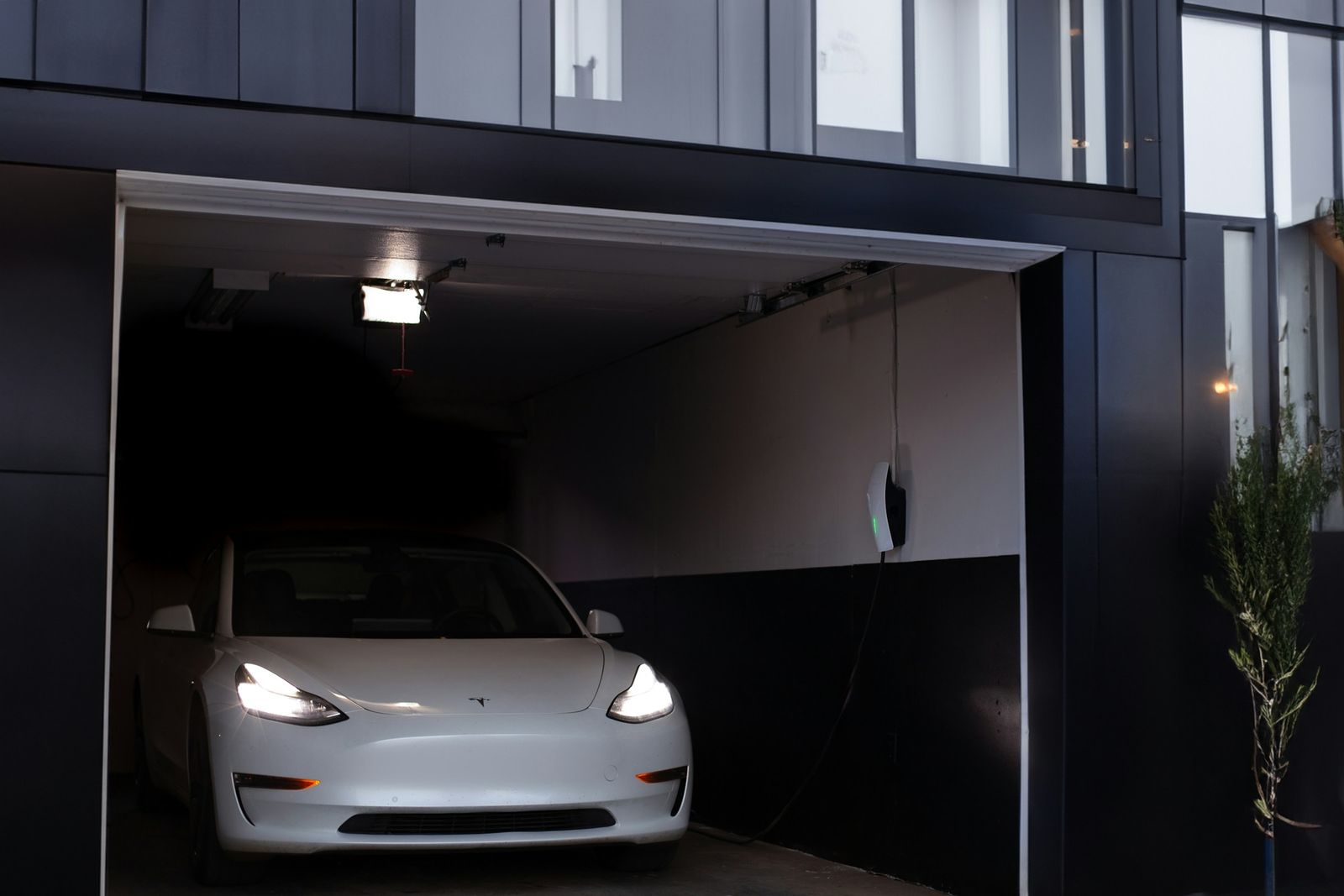
Is a regular outlet enough, or do you need Level 2?
A standard 120-volt outlet (Level 1) adds about 5 miles of range per hour, so an 8-hour night buys you about 40 miles, according to the Department of Energy. That covers a short commute and not much else. A Level 2 charger runs on 240 volts in a house (208 volts is typical in commercial buildings) and puts out anywhere from 2.9 to 19.2 kW.
Here’s what each common setting delivers at 240 volts for a car that goes 3.5 miles per kWh, which is close to the EPA rating of a Model Y Long Range, BMW i4 or VW ID.4.
Level 1 vs Level 2 at 240 V, at 3.5 miles per kWh| Setup | Power | Miles per hour | Miles in 8 hours |
|---|
| Level 1, 120 V outlet | Up to 1.9 kW | About 5 | About 40 |
|---|
| Level 2, 24 A | 5.8 kW | 20 | 161 |
|---|
| Level 2, 32 A | 7.7 kW | 27 | 215 |
|---|
| Level 2, 40 A | 9.6 kW | 34 | 269 |
|---|
| Level 2, 48 A | 11.5 kW | 40 | 323 |
|---|
If you drive 40 miles a day, a 32 A charger refills that in under two hours. The bigger settings matter when you come home low, share a garage between two cars, or drive a truck that uses more energy per mile.
Level 1 still has a place. A plug-in hybrid with a small battery, or a second car that does short errands, can live on a garage outlet. DOE notes that most residential Level 2 chargers run at up to 30 amps and about 7.2 kW, good for roughly 25 miles of range an hour. Going to 40 or 48 amps buys speed for a bigger battery or a second car.
Which charger should you buy?
Buy for the car’s onboard charger, because the car sets the ceiling. Tesla’s Wall Connector tops out at 48 A (11.5 kW), and Tesla lists the Model 3 and Model Y rear-wheel-drive versions at 32 A (7.7 kW). Kia rates the 2026 EV9’s onboard charger at 10.9 kW, and VW says the 2026 ID.4 charges at up to 11 kW. Setting a charger above what the car accepts doesn’t charge it faster.
Many wall chargers can be turned down to fit the circuit, and the 2023 NEC requires that adjustable setting to be marked on the rating label (625.42). That’s handy when the panel can only spare a 40 A breaker today.
Plug-in or hardwired? A charger that plugs into a NEMA 14-50 outlet is on a 50 A circuit, so it can be set to 40 A at most, and the 2023 NEC requires GFCI protection for receptacles installed for EV charging (625.54). Above 40 A a 14-50 can’t carry it, so the charger gets hardwired.
What size breaker and wire does a charger need?
The breaker has to be at least 125% of the charger’s current, because the code treats EV charging as a continuous load (2023 NEC 625.41 and 625.42). The wire gets the same treatment. NM-B cable is held to its 60 °C rating, so it often runs one size bigger than THHN pulled through conduit. California’s current code, the 2025 California Electrical Code, is based on the 2023 NEC and took effect January 1, 2026.
Charger setting, breaker and minimum copper wire| Charger | Breaker | THHN in conduit (75 °C) | NM-B (60 °C) |
|---|
| 16 A | 20 A | 12 AWG | 12 AWG |
|---|
| 24 A | 30 A | 10 AWG | 10 AWG |
|---|
| 32 A | 40 A | 8 AWG | 8 AWG |
|---|
| 40 A | 50 A | 8 AWG | 6 AWG |
|---|
| 48 A | 60 A | 6 AWG | 4 AWG |
|---|
| 64 A | 80 A | 4 AWG | 3 AWG |
|---|
| 80 A | 100 A | 3 AWG | Use THHN |
|---|
For a Model Y Long Range, that works out like this: a 48 A Wall Connector on a 60 A breaker with 6 AWG THHN or 4 AWG NM-B charges at 11.5 kW, about 43 miles an hour. The same car on a 14-50 plug-in capped at 40 A gets 9.6 kW, about 36 miles an hour, or about 284 miles over an 8-hour night.
Long runs to a detached garage can need a bigger wire for voltage drop, and your inspector has the final say. For your car and your numbers, use the EV charger calculator.
Two EVs in one garage: two circuits or one?
Often one. A charger rated over 16 amps normally gets its own branch circuit (625.40), but the 2023 NEC lets several share one when an energy management system keeps the total in check (625.42), and 220.70 lets the load calculation use that system’s setpoint instead of adding both chargers at full power.
Tesla’s Gen 3 Wall Connectors do this out of the box: up to six units (one leader, five followers) share a limit the installer programs, and Tesla says no internet connection is needed. If a 48 A limit splits evenly, each car gets 24 A, about 5.8 kW, or roughly 160 miles of range apiece over an 8-hour night at 3.5 miles per kWh.
Mixed brands can work too if the chargers support load sharing or you add a separate load manager. That can keep a second car from forcing a panel upgrade.
Does your panel need an upgrade?
Only a load calculation answers that, and it’s the first thing to do before buying hardware. A 48 A charger means a 60 A circuit that can run at full current for hours. Start with the panel load calculator; you’ll need the main breaker size printed on the panel label and a list of your big appliances.
If the numbers come up short, there are three ways out: a smaller charger setting, a load-managed charger that backs off when the house is busy, or a panel or service upgrade. A service upgrade also involves the utility: SDG&E takes it through Apply for Service (it says to allow two weeks for review), and SCE starts requests at sce.com/projectrequest.
What’s safe to check yourself: the panel label, the number on the main breaker and whether there are open spaces. Don’t remove the panel cover. If you notice a burning smell, a hot panel or scorch marks, shut off that breaker and call an electrician.
What does charging cost on SDG&E vs SCE?
Overnight on SDG&E’s EV-TOU-5 is the cheapest rate of the four plans below, at 13.1¢/kWh from midnight to 6 a.m. in summer (prices effective August 1, 2026). The catch is 4 to 9 p.m., when the same plan charges 80.2¢. SCE’s TOU-D-PRIME is flatter. Many South County cities, Mission Viejo among them, are split between the two, so check the utility finder or your bill.
A Model Y Long Range, 1,000 miles a month, summer (27 kWh/100 mi)| Plan | Overnight | Per month | 4–9 p.m. | Per month |
|---|
| SDG&E EV-TOU-5 | 13.1¢/kWh | $35 | 80.2¢/kWh | $217 |
|---|
| SDG&E TOU-DR1 | 37.4¢/kWh | $101 | 69.1¢/kWh | $187 |
|---|
| SCE TOU-D-PRIME | 26.0¢/kWh | $70 | 59.0¢/kWh | $159 |
|---|
| SCE TOU-D-4-9PM | 34.0¢/kWh | $92 | 58.0¢/kWh | $157 |
|---|
The same 1,000 miles in a 25 mpg car is about $249 at the aaa orange county average, regular of $6.22 (AAA, September 22, 2026). SCE prices are shown rounded to the cent after its June 1, 2026 change. Both utilities add a Base Services Charge of about $0.79 a day, EV or not. In Irvine, Orange County Power Authority supplies the power and SCE still bills it.
On SDG&E, EV-TOU-5 is for households with an EV registered with the DMV, and it only pays off if the car charges after midnight. Set the schedule in the car or the charger app so it starts at 12:00 a.m., not when you pull in at 6 p.m. SDG&E’s standard TOU-DR1 charges 37.4¢ for the same overnight hours in summer, before a 10.7¢ baseline credit that covers only your first 130% of baseline use. SDG&E says the roughly $24-a-month Base Services Charge, on bills since October 2025, came with per-kWh prices about 10% lower.
On SCE, TOU-D-PRIME is open to households with an EV or plug-in hybrid, a home battery, or an electric heat pump. Its summer off-peak price covers every hour outside 4 to 9 p.m., so the schedule matters less than on SDG&E.
Permits, condos and HOAs
A charger install needs an electrical permit, and California makes cities process it quickly. AB 1236 (2015) and AB 970 (2021) require a streamlined ordinance, checklists posted online, electronic signatures, and a review limited to health and safety. For 1 to 25 chargers, an application is deemed complete after 5 business days and approved 20 business days after that if the city hasn’t acted. A city can’t make HOA approval a condition of the permit. Check your city’s process with the permit checker. We pull the permits for the chargers we install.
In a condo or planned community, Civil Code 4745 says the association can’t prohibit or unreasonably restrict a charger in your unit or assigned parking space. It can set reasonable rules that don’t significantly raise the cost or cut the charger’s efficiency. If it doesn’t deny your application in writing within 60 days, it’s deemed approved. In return you pay for the install and the electricity, use a licensed contractor, carry a liability policy and give the association a certificate within 14 days of approval, and disclose the charger when you sell.
Some condo buildings have 208-volt service, which cuts charging power by about 13% at the same amps.
What an install involves, and what incentives are left
A typical job goes like this: photos of the panel label and the spot where the car parks, a load calculation, the permit, the circuit and charger, then the city inspection. A service upgrade adds the utility’s review and scheduling. Mount the charger where the cable reaches the car’s charge port without stretching across the walkway, and think about where a second car will park. See how we handle it on the EV charger installation page, or text Shane a photo of your panel.
The federal Alternative Fuel Vehicle Refueling Property Credit (30C) paid 30% of the cost, up to $1,000 per charging port, in low-income or non-urban census tracts. The IRS says it covers property placed in service January 1, 2023 through June 30, 2026, so a charger installed now doesn’t qualify.
SCE’s Charge Ready Home program has offered income-qualified customers (under 80% of area median income) a rebate meant to cover up to the full cost of a panel upgrade. Its FAQ doesn’t say whether it’s still open in 2026, so check with SCE before counting on it.